

Did you know that Dorothea Dix Park used to be the site of an old psychiatric hospital? Or that it was almost turned into a shopping center? These are just a few facts we learned on our free walking tour of Dorothea Dix Park, which run every once a month in Spring and Summer.
We thoroughly enjoyed this unique way to explore Raleigh’s largest urban park, and what a great way to learn about the fascinating history of the park, and its future development!
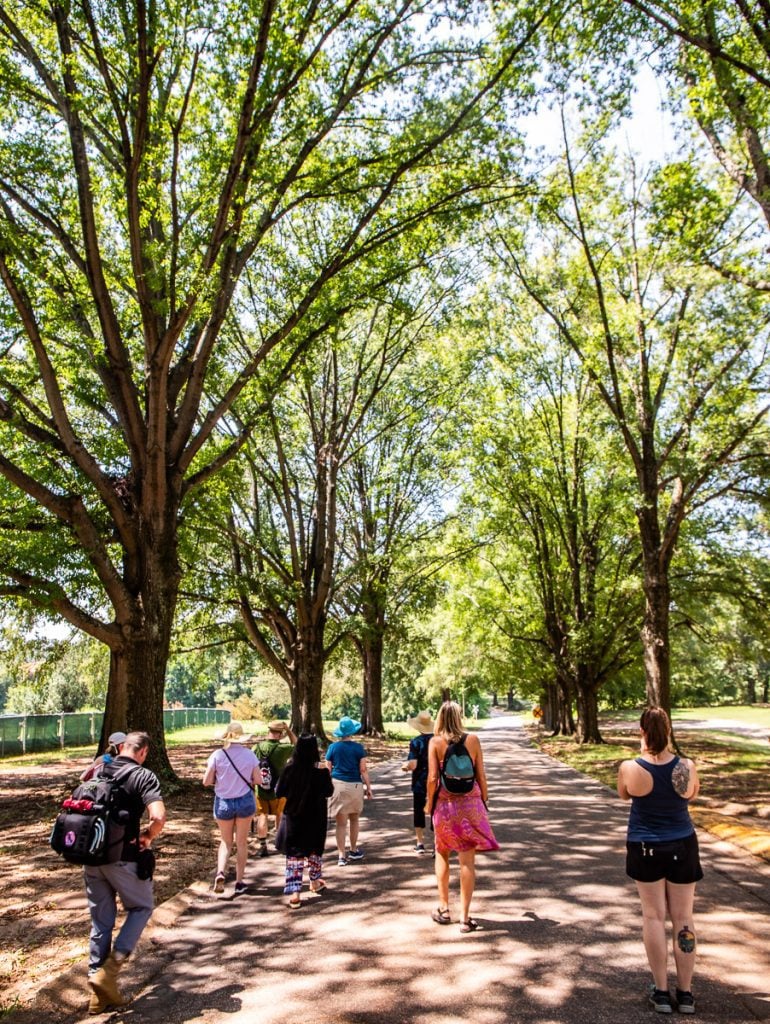
A free walking tour here is both a ramble through nature and history, learning about past, present and future. When a free Saturday appeared in our schedule, we booked ourselves in and made our way to Dorothea Dix Park for a wonderful two-hour walk around the gorgeous grounds to learn some of the history of Raleigh from the Civil War to Civil Rights. Our schedules were free; the weather was perfect – less than normal summer humid conditions – and the park so peacefully quiet. Here’s what we experienced…
About free walking tours of Dorothea Dix Park
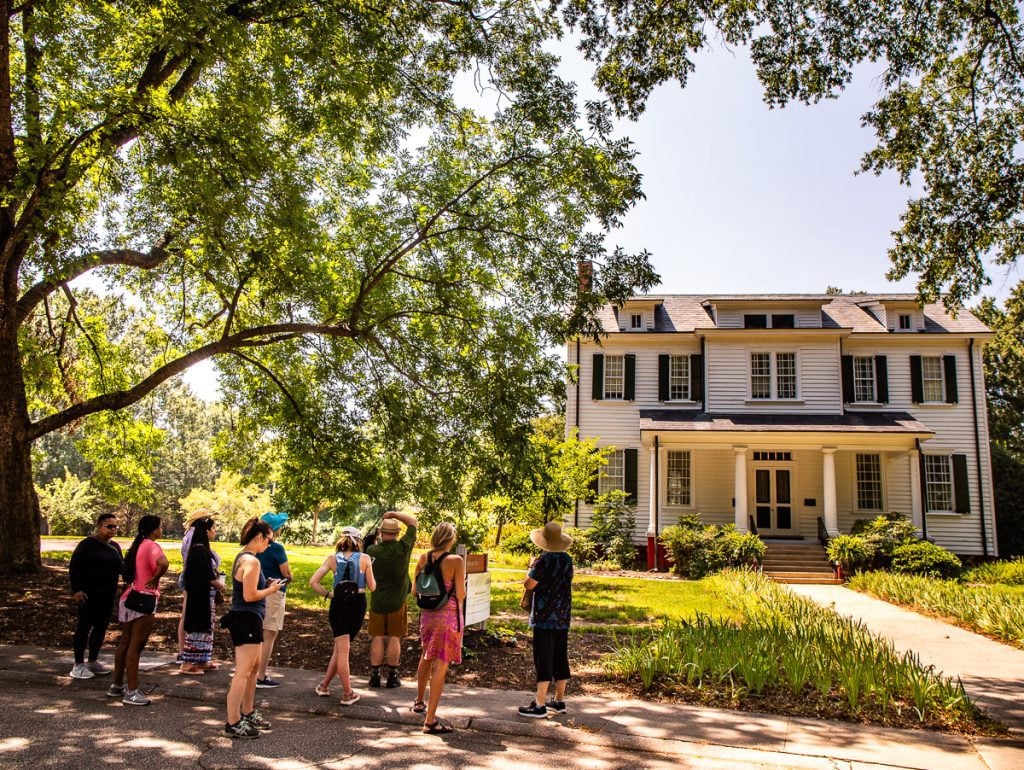
Dorothea Dix Park hosts a free, 2-hour walking tour, which runs on the second Saturday of the month in April – July. You will walk for around 2.5 miles through the park. While there are accessible pavements, not all of Dorothea Dix is flat and there are some uneven surfaces, so you will need to be comfortable walking for this length of time. Wear appropriate footwear. While the tour is free, you need to register to secure your place, as the tour is limited capacity. They open registration two weeks before the date of the tour at 12pm, so you need to mark the time down in your calendar to make sure you get a spot in time.
If you’ve never done a free walking tour before, you might wonder “what’s the catch?” Generally, with free walking tours, you are expected to give a tip at the end of the tour if you enjoyed the experience. You can give as much or as little as you like but try to be reasonable as tour guides take time out of their weeks to volunteer to do this.
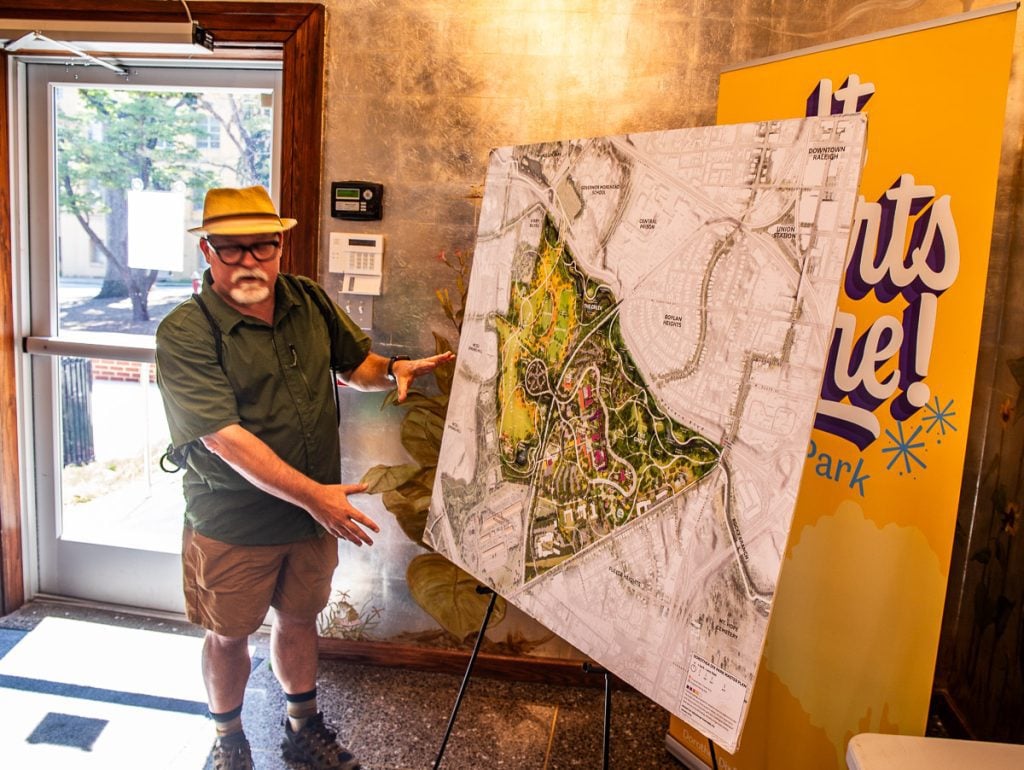
Adam was our volunteer guide, and he was knowledgeable, passionate, and friendly. His passion stems from a career as a psychologist, but also just an interest in the history of Dix Park and Raleigh. He was an informative guide with a relaxed and easy-going nature. It felt like we were walking with a friend.
It’s not surprising this walking tour is so popular though. We learned so much about how this urban park at downtown’s door is poised to be one of the biggest and best new city parks in the USA! See registration details here.
Our experience of the free walking tour
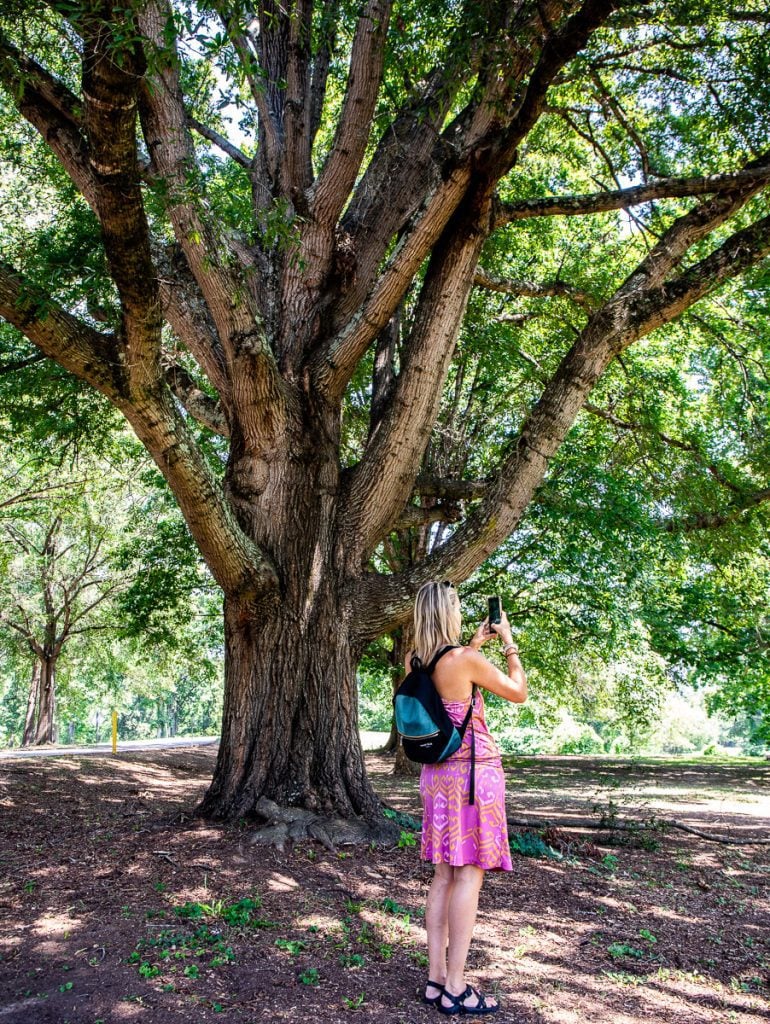
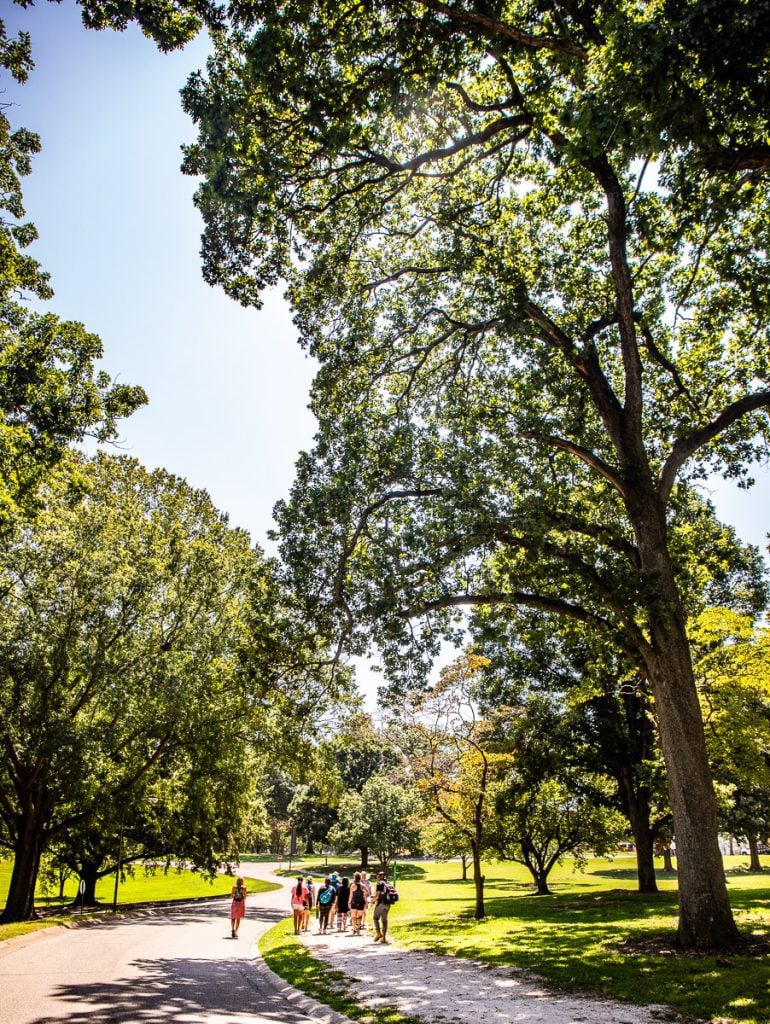
As we walked under the shades of magnificent oak trees – resisting the temptation to hug them – Craig and I tried to recollect our experience with Dorothea Dix before our relocation back to Raleigh in 2017. The psychiatric hospital closed in 2012, so we lived here twice when it was operating. While the park lands were free for people to come in and roam, neither of us remembered doing so.
We always saw those old houses on the hill, but I don’t think we realized we could even enter given it was a mental health facility for in-patients and out. When we returned to live in Raleigh in 2017, it was now in the hands of the City of Raleigh and suddenly we had this 308-acre parkland to explore with fun festivals like Falling for Local and Dreamville, crazy Kirby Derby races, sunset picnics with friends, and sunflower fields and Christmas lights.

Even though we’ve made quite good use of it over recent years, we still didn’t know much beyond the fact that it was once a state-owned psychiatric hospital with arguably the best views in Raleigh. We could only hear a blast of music and the hum of a food truck every now and then as they were setting up for the annual Kirby Derby that afternoon, which we regrettably had to miss due to playing Uber driver to our children!
A place of conscience: honor the past
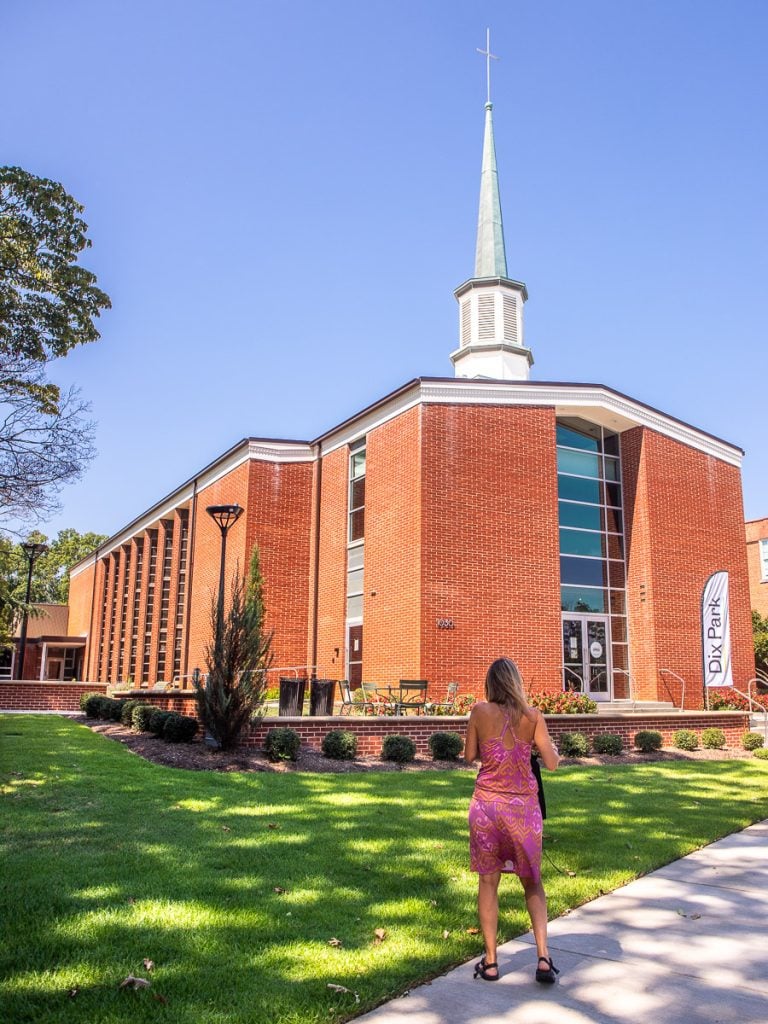
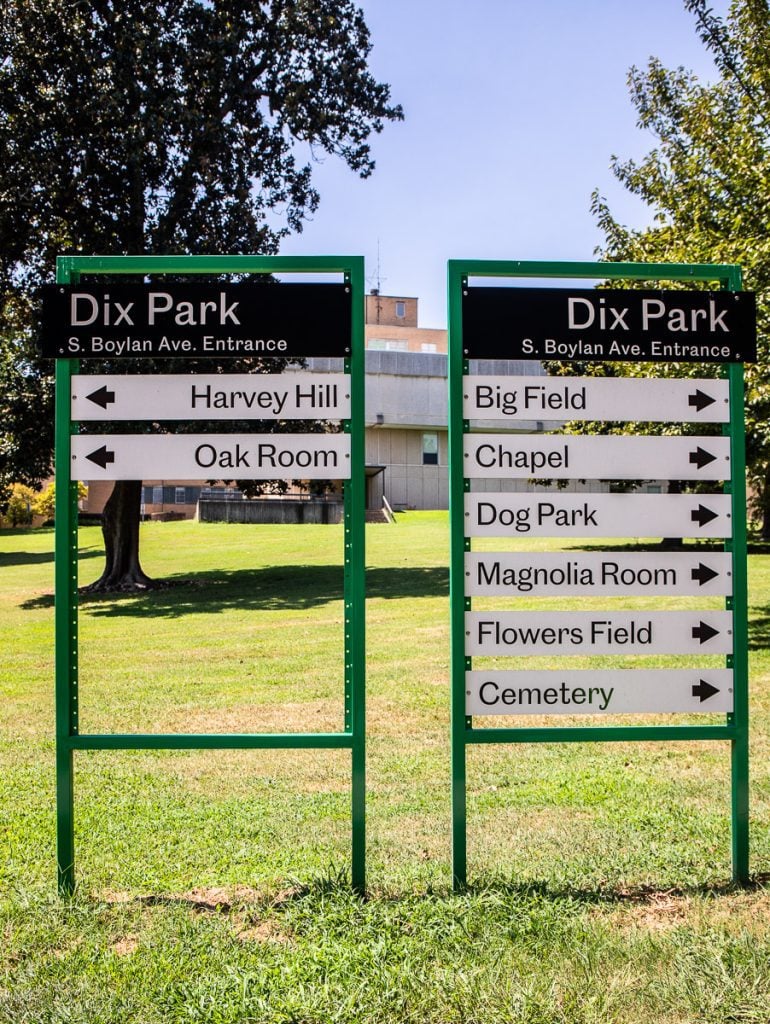
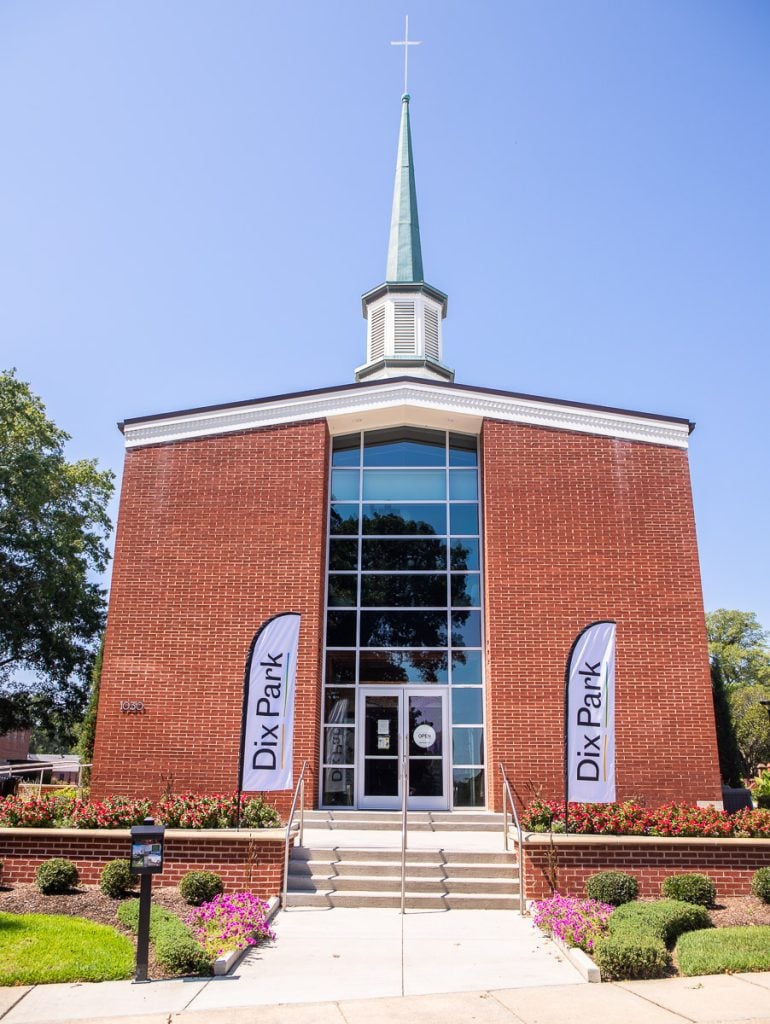
Our day began with a coffee and gluten-free coffee cake at nearby Rebus Works in Boylan Heights, as we knew we were about to do a lot of walking (and learning!). Then, at 12pm sharp, we met Adam, our volunteer tour guide for the afternoon, and our small group at one of the first landmarks – the park’s Greg Pool, Jr All Faiths Chapel.
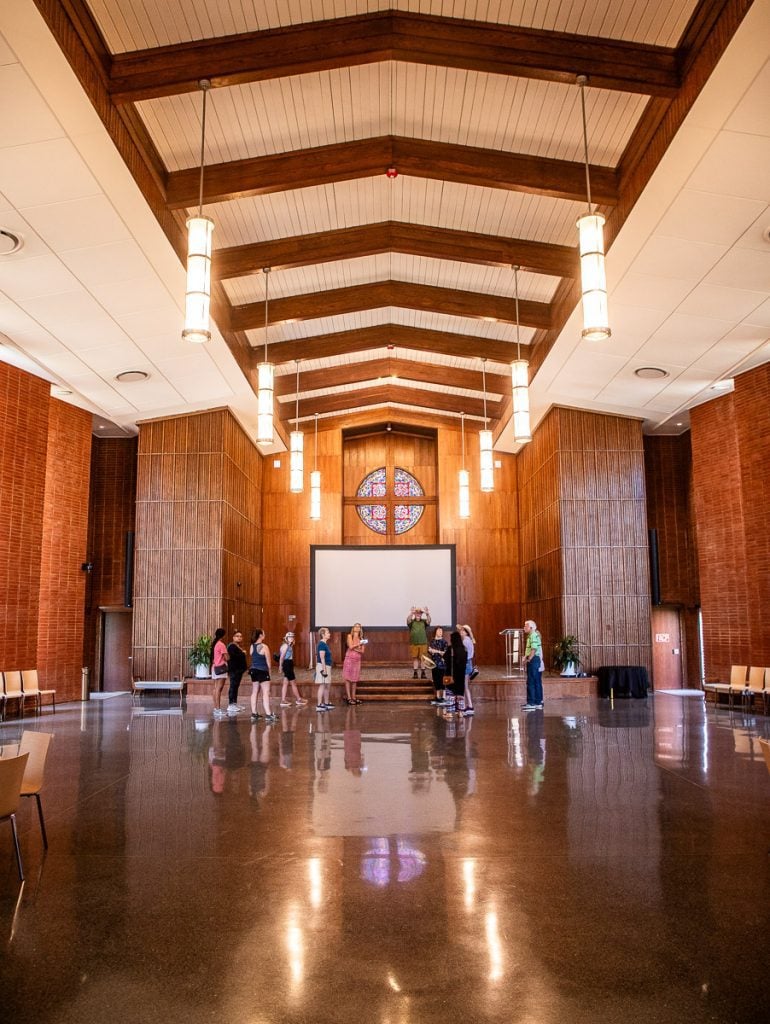
This dilapidated mid-century modern chapel was transformed five years ago and still retains some elements of old, like the terrazzo floor we were standing on in the foyer. There’s not a lot to see inside the chapel, but we had a look at the stained-glass religious icons on the glass wall panels, which were funded with private money.

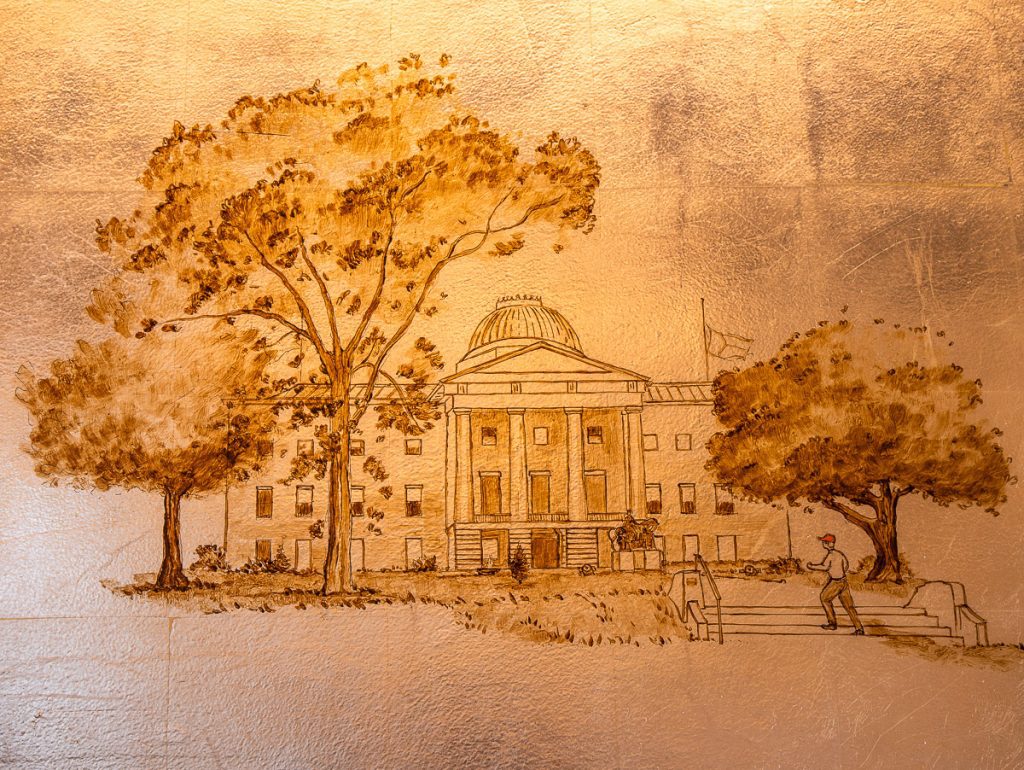
And we learned about the silver leaf mural covering the walls of the foyer. North Carolina artist Christopher Hold hand painted different representations and symbols of important Dorothea Dix connections such as slave, John Hunter, which we’d learn more about on the tour.

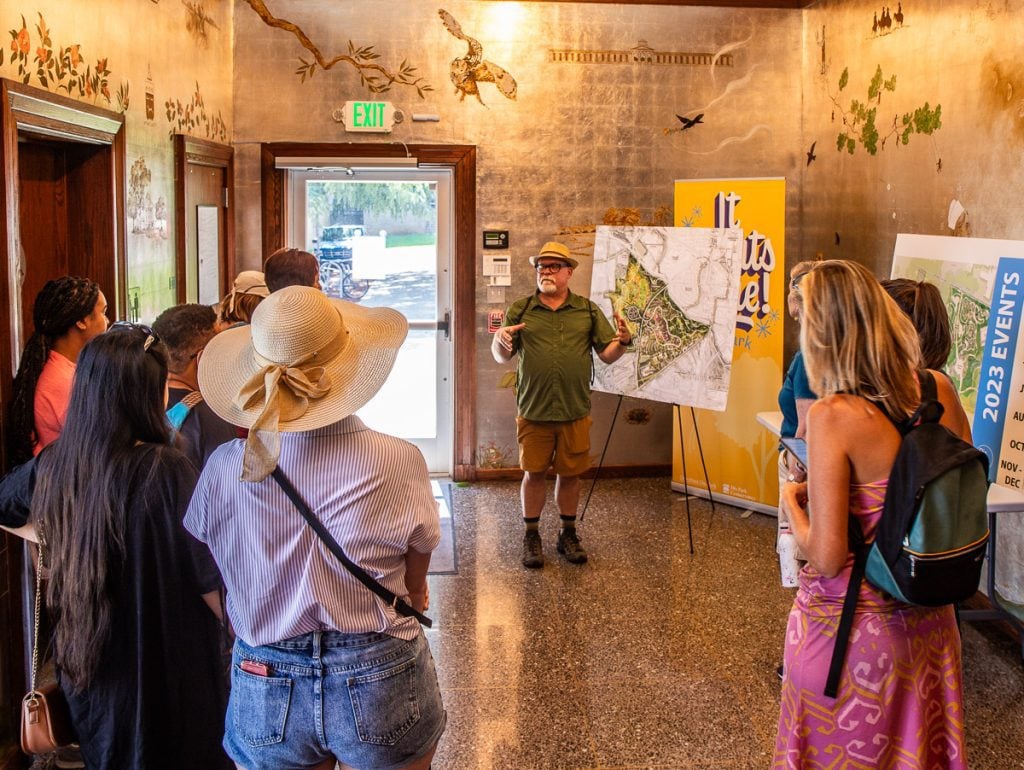
Adam began by greeting each of us, asking what we’d like to learn from the tour, and introducing the park in two important ways. Firstly, the recognition that the park is the traditional hunting and gathering lands of about six or seven native tribes. And secondly, Dix Park is a member of the International Coalition of Sites of Conscience, a global network of historic sites, museums and initiatives that recognize the importance of remembering past mistakes made in order to create ways that paint a better future for all.
The Dix Park Conservancy is committed to honoring the park’s history and building a unique place of belonging for all. Because y’all means y’all – no exceptions. NOTE: The guided tour now leaves from the Stone Houses Visitor Center, in one of the lovingly restored Stone Houses, and Adam does the same introduction from there. I encourage you to see the Chapel after your tour if you can!
The Stone Houses

In June 2024, the 1920s Stone Houses opened after extensive restoration made possible through a donation of $5 million by the State Employees Credit Union. The three historic 100-year-old stone houses near the front entrance of the campus are being restored to create a welcome and visitor center, community and classroom space, and additional public facilities and accessible pathways that allow more people to use the park. One of the stone houses – the Gatekeepers Cottage – was the former home of Dr. A. Meymandi, the mental facility’s superintendent (the same man who the Meymandi Hall is named after in downtown.
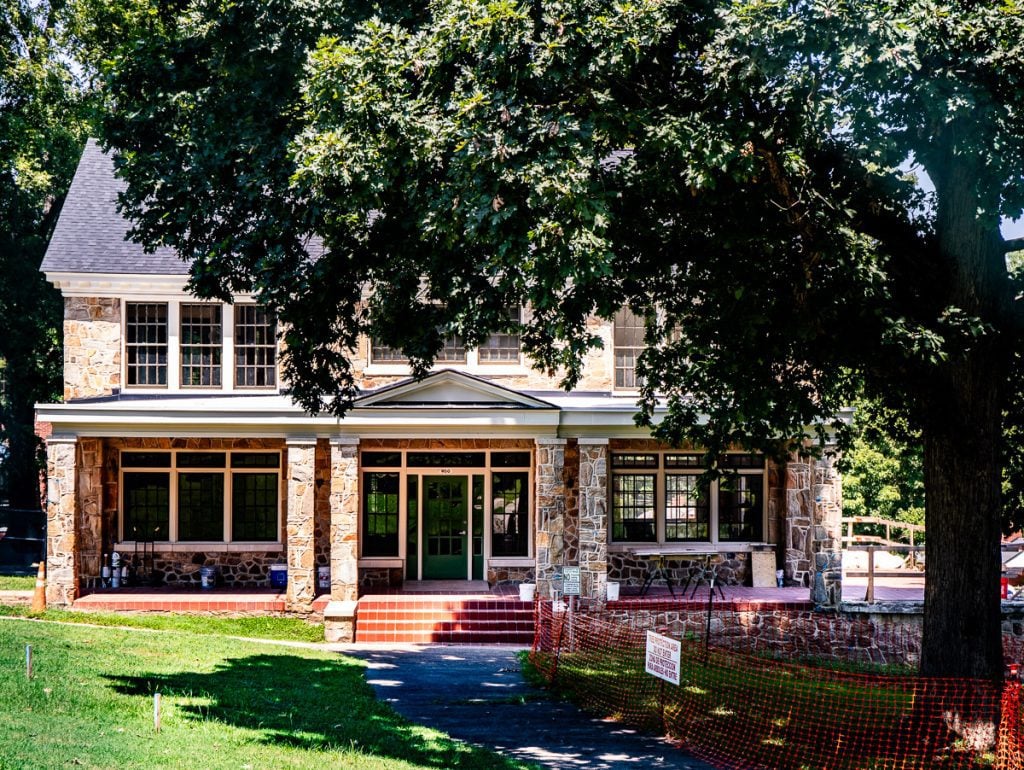
The Superintendent’s House will house the Dix Park Conservancy staff offices including meeting and conference space. The Physician’s House will provide office and classroom space for non-profits and community groups.

The Gatekeeper’s Cottage is proposed to serve as a welcome center for the historic Boylan Drive entrance at Dix Park. Inside the visitor’s center are information panels sharing more about the history and future of Dorothea Dix Park.


The area has public restrooms, lovely, shaded areas to sit, and the new public art installation, Attun, by American sculptor and teaching artist, DeWitt Godfrey.
The Better Future
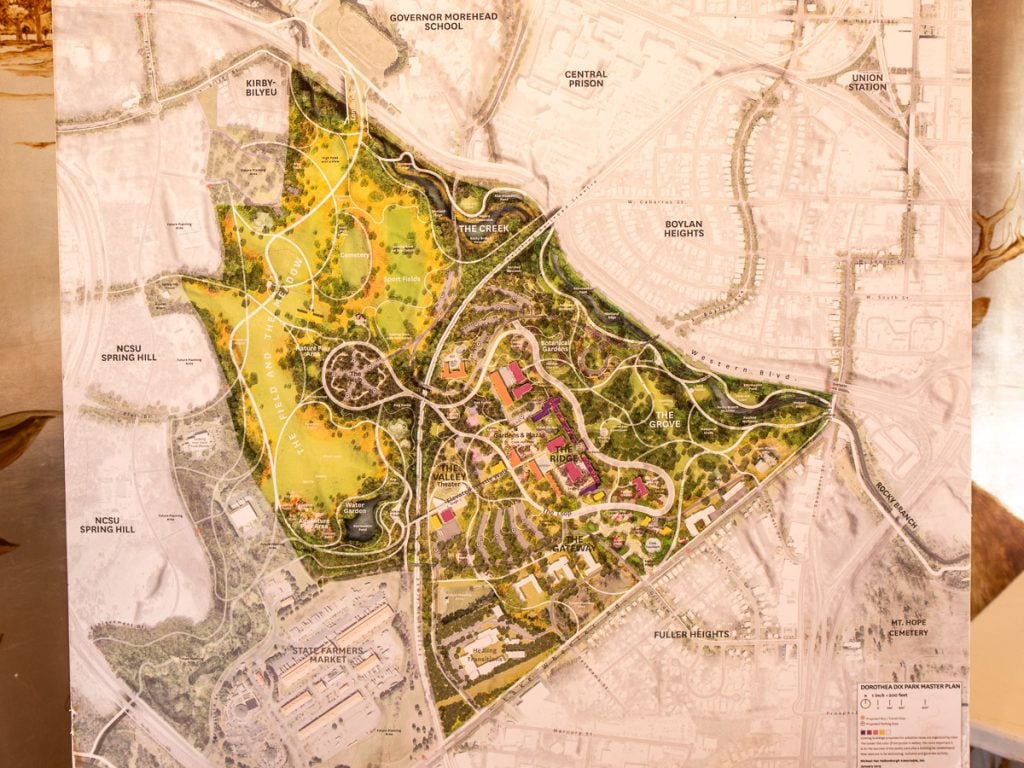
Adam shared with us the future 40-year plan for the development of Dorothea Dix Park, bringing it to life by pointing out all the features on the map plans. We did this 2.5-mile walking tour before the development of Gipson Play Plaza, which has since grown to one of the biggest attractions in the park (see our full guide to Dix Park here). The Gibson Play Plaza was first major project, and cost over $60 million. It contains a playground for all ages (unlike Pullen Park which is mostly for little kids) and features slides, climbing frames, works of art, a civic plaza, fountains, picnic groves, and gardens.
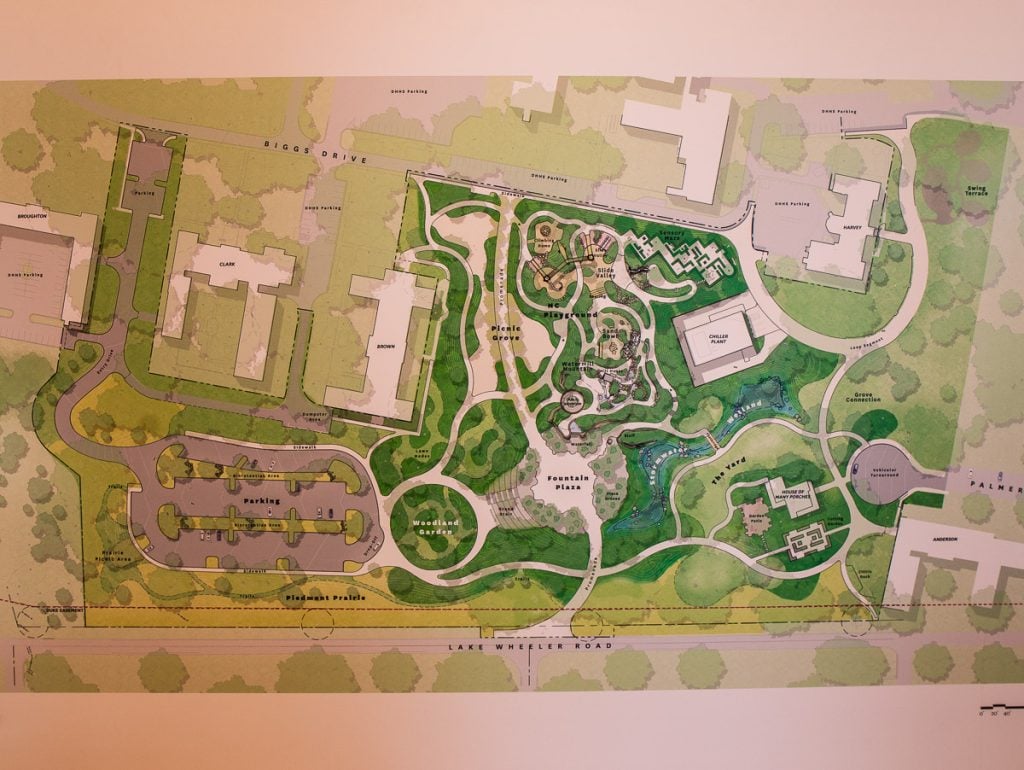
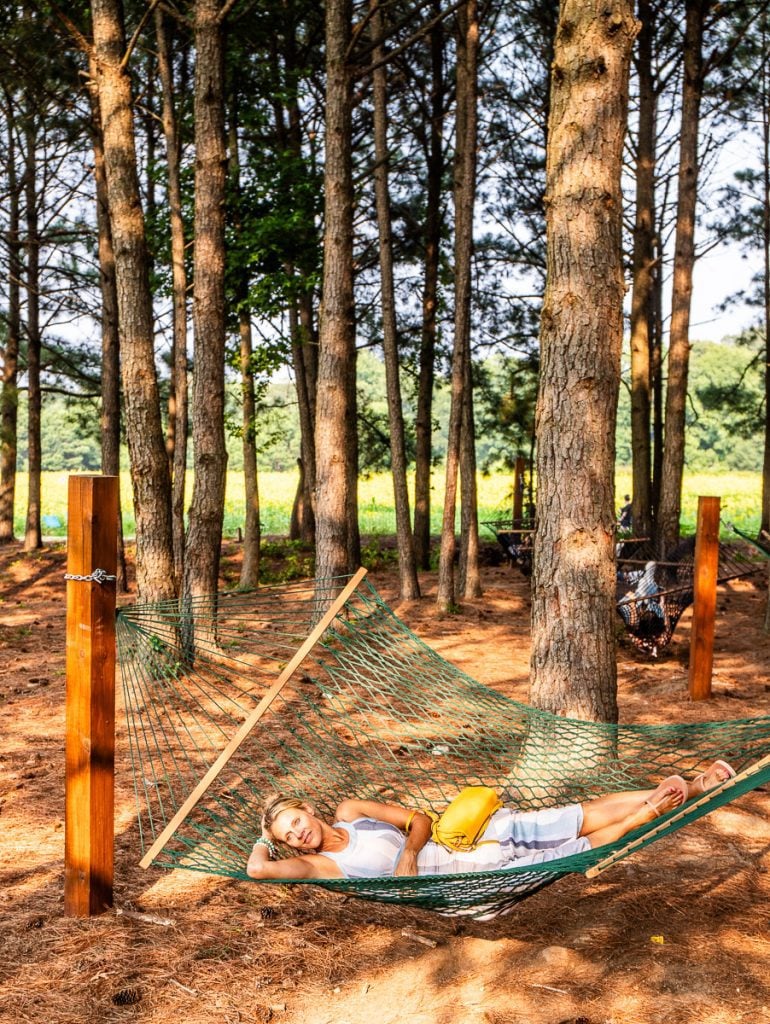
This plaza is not the last development of the park; there are five phases to the development plan – the duration of each phase and their related projects is dependent on funding and won’t necessarily be sequential. If funding comes in, like the recent donations of $10 million by the Gibson family for the Gibson Play Plaza, then they can start several projects at the same time. We hope more funding comes in as we want to experience many of these projects before we’re too old to do so! Inexpensive ideas have already been implemented like the hammock glens we found amongst the trees as we wandered around.
Some of the phases can’t start yet, as the 83 buildings that once comprised the psychiatric complex are currently used by the state health department who are leasing them from the City of Raleigh, who purchased Dorothea Dix Park from the state in 2015. A move by the mayor that kept the developers hands out of a prime piece of land right near downtown Raleigh. Thank you for that!
As soon as the health department moves into their new development at Blue Ridge near the NC Museum of Art, the city will take back leases on buildings. The plans are to leave around 35 houses for various uses such as conservancy offices, educational buildings and small museums. The idea is to create something like the Presidio in San Francisco which has transformed old army barracks into world class museums and community gathering spaces.
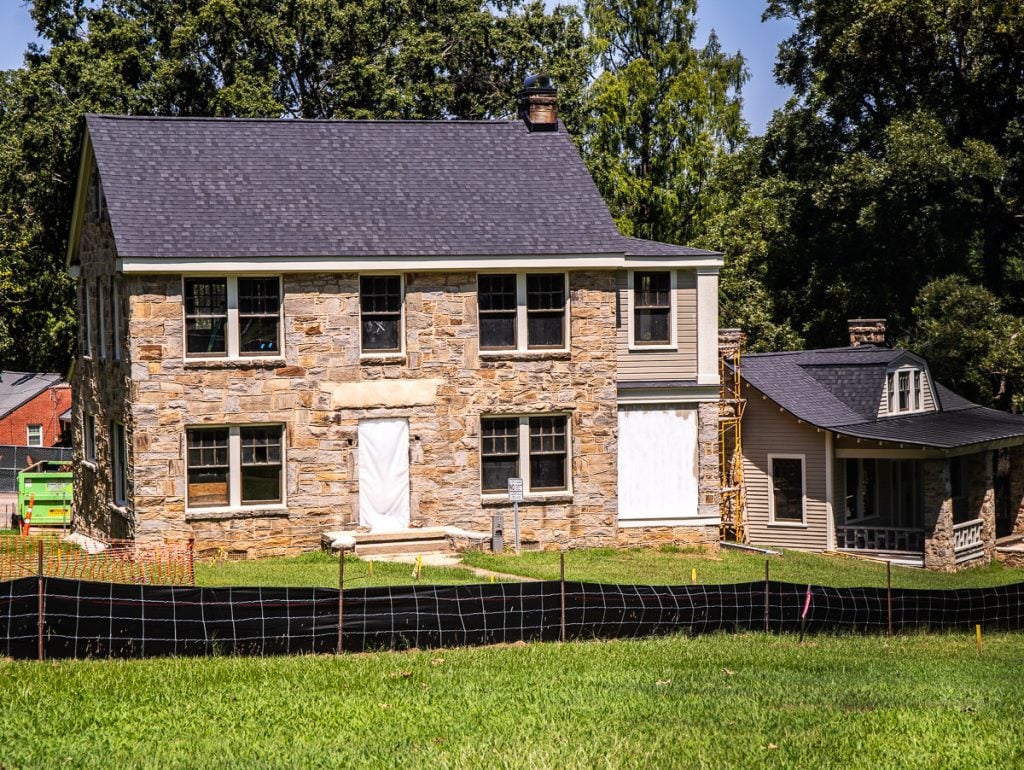
The rest will be demolished so the land can be returned to its natural state. Yes. This will be a city park for the people to enjoy walking paths, bike trails, tranquil creeks, and beautiful gardens. Of course, the plans don’t come without challenges, mostly issues with parking and navigating around busy Raleigh traffic to connect Dorothea Dix with Downtown Raleigh, in particular the Convention Center and downtown hotels, as well as the neighboring State Farmers Market, which at the moment has no clear and safe way of connecting the two.
Although they are building a pathway that will connect Dorothea Dix to John Chavis Park on Martin Luther King Jnr. Blvd.
The Dorothea Dix Hospital
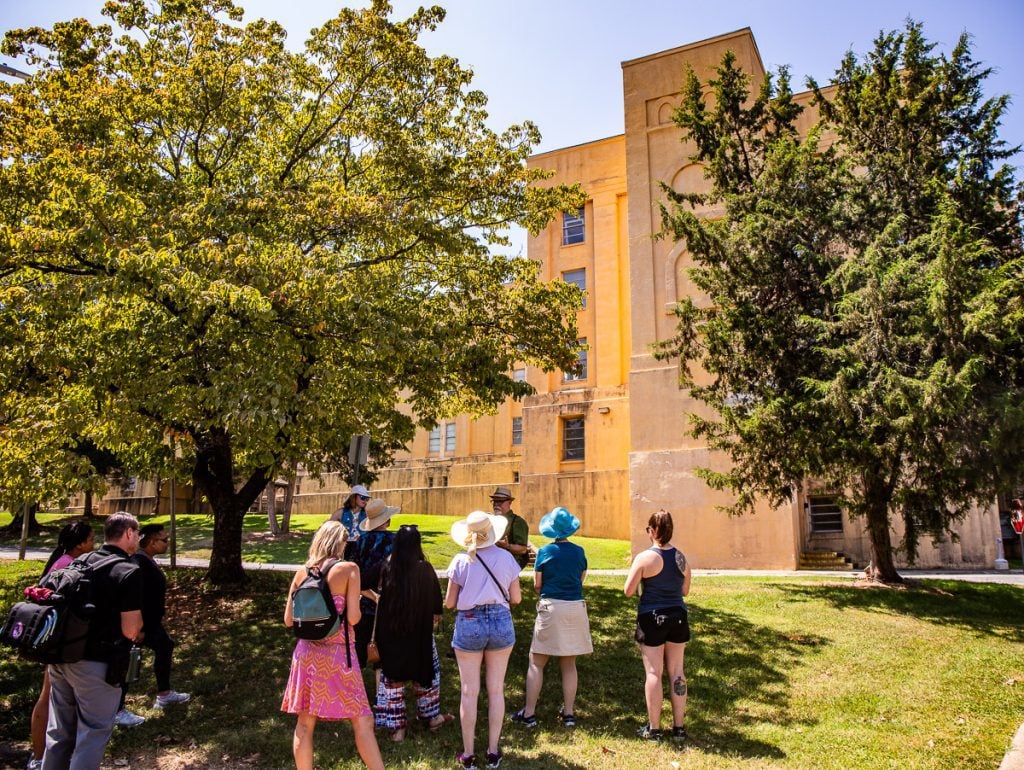
After our introduction in the church, the rest of the tour was spent walking around the grounds of the park and wandering past points of interest to learn more. It wouldn’t be a worthy tour of Dorothea Dix Park if we didn’t learn something about the 150-year history of the mental health facility here.
We stopped outside the pale-yellow Tuscan Italianate design building of the hospital. It was painted this color, instead of its original white, as Tuscan architecture uses sandstone. The designer, AJ Davis, who was good at faking, drew lines on the building to make it look like it was built with big blocks of sandstone. It’s stucco over Raleigh red brick.
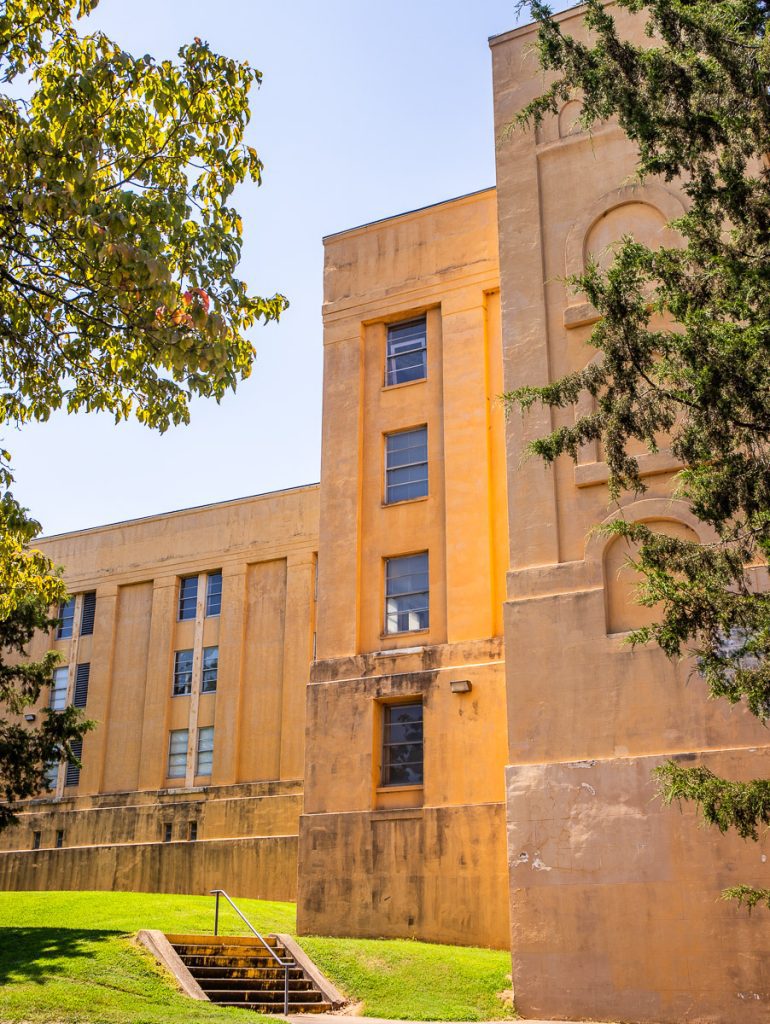
More interesting than the building’s design was learning about the Dorothea Dix hospital complex that was built in 1856, featuring 83 buildings, serving inpatient and outpatient people with mental health needs. Dix became a place of safety and care for the patients – even though Adam acknowledges many mistakes were made in their treatment and care.
The hospital included a Forensic prison unit, easily recognized by the bars on the window – the only place in the complex that has them. Extremely dangerous and violent people live here – the criminally insane, who could not stand trial because of their insanity. Dix helped most of the patients get better and then they were able to stand trial.
Many innovative mental health treatments were tried and implemented at Dorothea Dix as was facilitated by many of the Chapel Hill University medical staff who were at the forefront of the field. The hospital opened with 274 patients in the beginning, moving up to 2700 at its peak in the early 70s. Only whites were treated until the 60s, when the hospital was backed by federal money, which meant federal rules had to be followed, and it became fully integrated.
Eventually the hospital closed in 2021 due to declining need and limited care left. As mental health medicine and practices improved over the years, the need for facilities like this declined. Funding was also moved more towards community care therapies rather than hospitalizations. Only 600 patients remained. About half were placed into community care and the other half went to North central in Oxford.
Although, many who had connections with the former hospital and medical care have pointed out in this Facebook update, that the facility was in fact shut down because the government wanted to use the land for their own reasons. I can see that point, but also on the tour you learn some other important factors that some may not know about. One being that it did cost 8-10 million a year just for utilities.
It just wasn’t financially viable to keep running such a big mental health facility when so much changed in positive ways – e.g. improved therapies that reduced the need for in-hospital care. Many of the conditions that people were admitted for in here, could now be treated in-community. When you learn this side of it, you’re less inclined to believe it was an all-out heartless decision to evict those in need purely just to get the land. Unfortunately, it did mean some who needed help fell through the cracks, which sounds like it could have been handled in a better way. But I’m not educated enough on the topic to really comment on that.
Who was Dorothea Dix?
The hospital followed much of the moral philosophy of psychiatric care developed by its namesake, Dorothea Dix back in the 1800s. Dorothea Dix was a well-educated woman from Boston who developed into a prominent person, first opening a state school for girls when she was 19 and then becoming one of the most well-known nurses in the country creating 32 hospitals and becoming the Superintendent of Army Nurses during the Civil War. She was charged with organizing and overseeing the nurses in the Union Army hospitals.
Her greatest work and achievements came with her advocacy for mental health. Her passion for helping those mentally unwell came from the time she spent in London recovering from tuberculosis with help from family friends.
They were quakers at the forefront of ministry into prisons, and she spent time helping them. It was here that she got the idea many of the prisoners were suffering from serious mental illness and should be in mental hospitals rather than prisons. She came back to the USA with a moral philosophy of psychiatric care that focused on nurturing the moral lives of patients. Treatment included lots of windows, lots of fresh air, sunlight, open air, purposeful work, community.
This was revolutionary thinking for her time but is like what people would prescribe for anyone suffering from any kind of mental health affliction. She came to North Carolina to lobby for funding for psychiatric hospitals as they had none. She was rejected. However, politician James Dobbin was staying across from her room in the hotel and he had a sick wife who she helped care for. On her deathbed, she promised Dorothea that she’d encourage her husband to convince the assembly to fund the hospital.
His passionate speech got the funding and, 8 years and a lot of slave labor later, the hospital was built. As you can tell from walking around the complex, the hospital did follow those principles of fresh air, connection to nature, open windows, and light filled rooms, and patients serving the community in various roles. It really was a hospital that sought to offer more compassionate care for those suffering from mental illness.
The Grove (for that Raleigh skyline view)

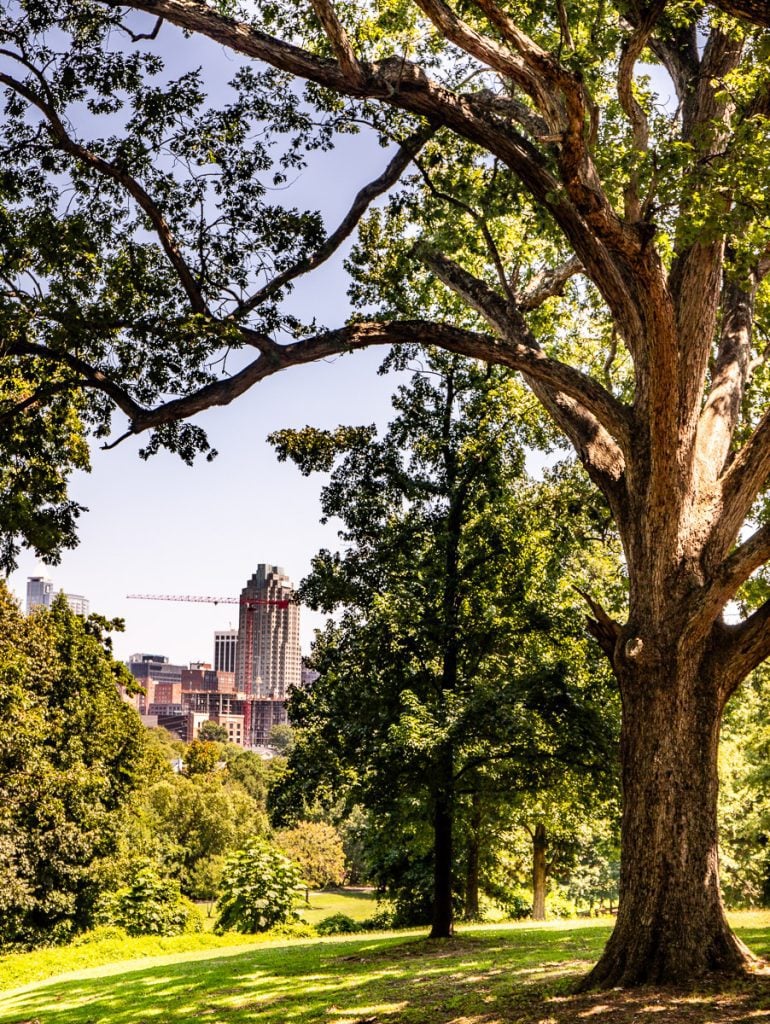
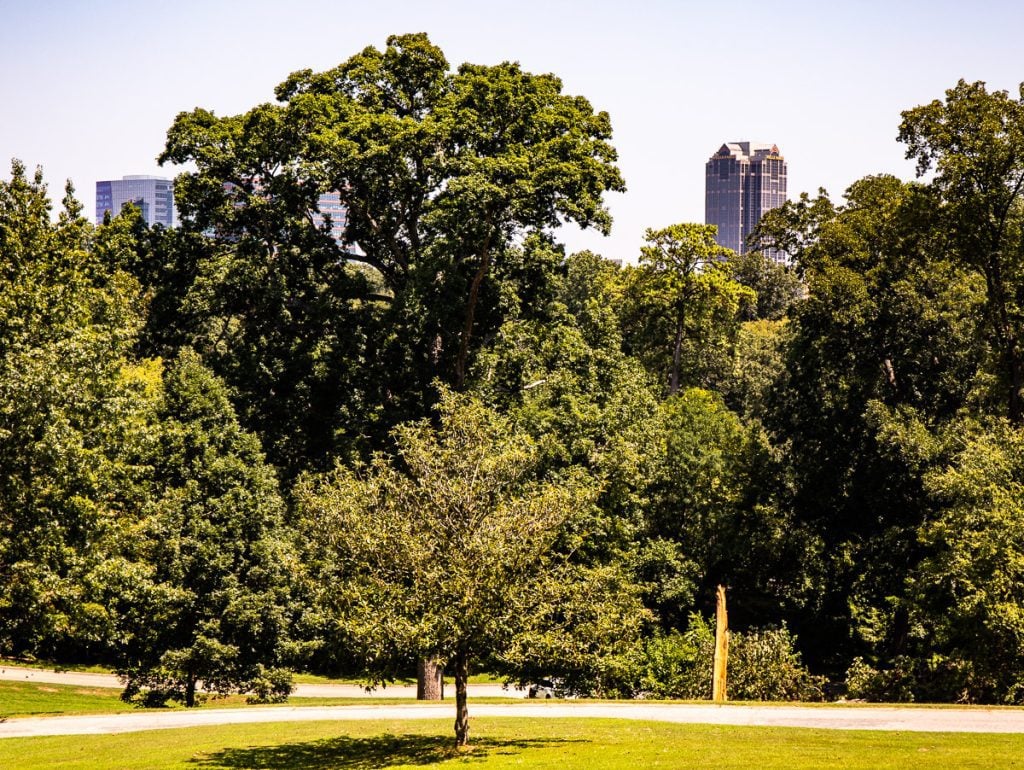
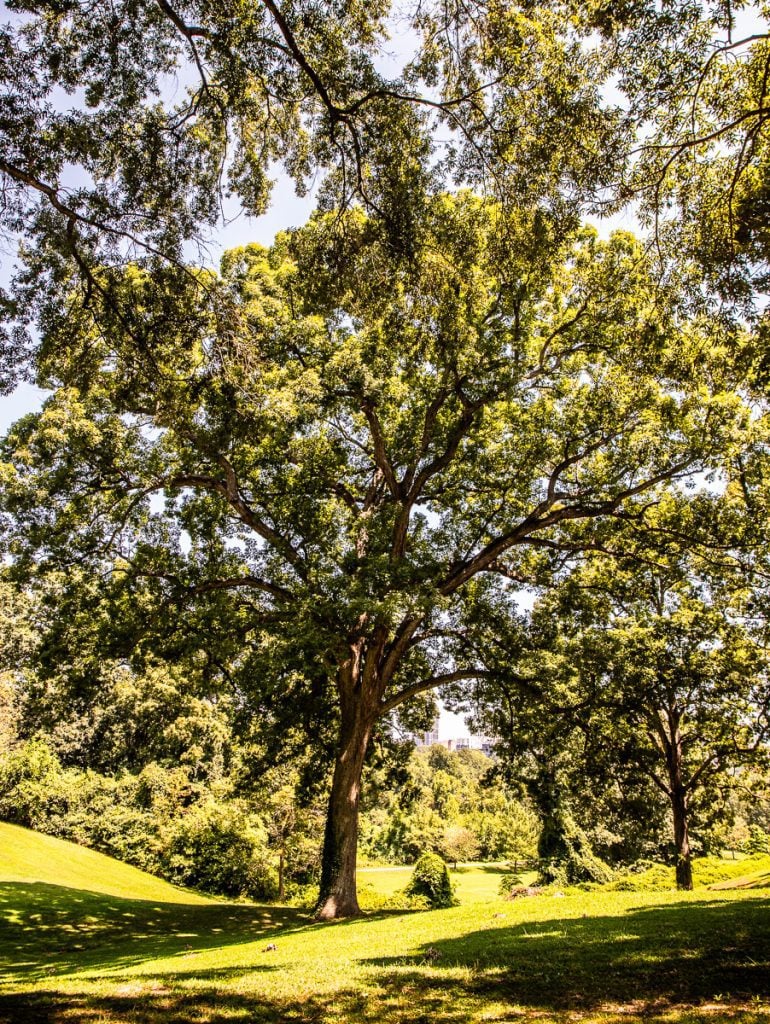
Adam then took us to what he thinks is the best view of Raleigh – but agrees it’s debatable against the other view (we’ll see later) near the sunflower fields. I say make sure you see both. This view is in the Grove area, the oldest intentionally planted Grove in the park taking up about 30 acres. So you’ll find plenty of shady oak trees to sit under as you admire the view. Adam also pointed out the future plans for the flat land below next to the Rocky Branch Creek, which runs along the northern boundary of Dix Park next to Western Boulevard.
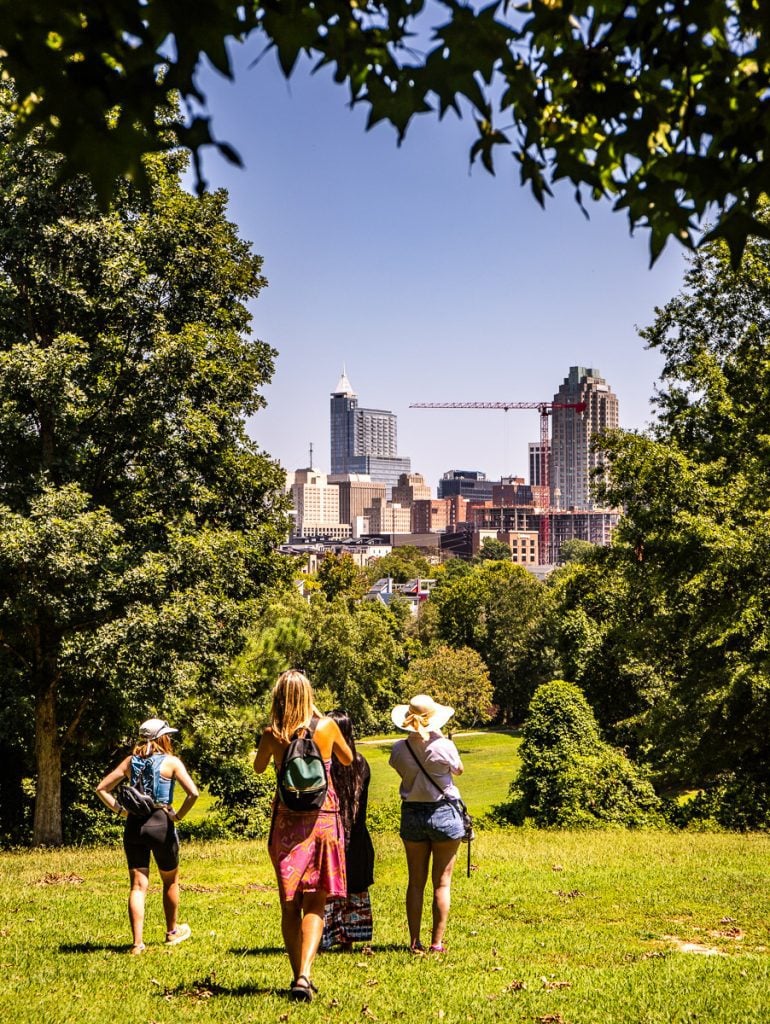
Over the years, this creek has become unhealthy, inaccessible, and empty of wildlife. In order to restore this creek, they plan to widen the floodplain, remove invasive species, stabilize the banks with native plants, and create natural systems to manage runoffs and help the water naturally filter out pollutants. They also plan to create a marshland to bring back wildlife. Who doesn’t like to wander beside a meandering creek for a little zen time?
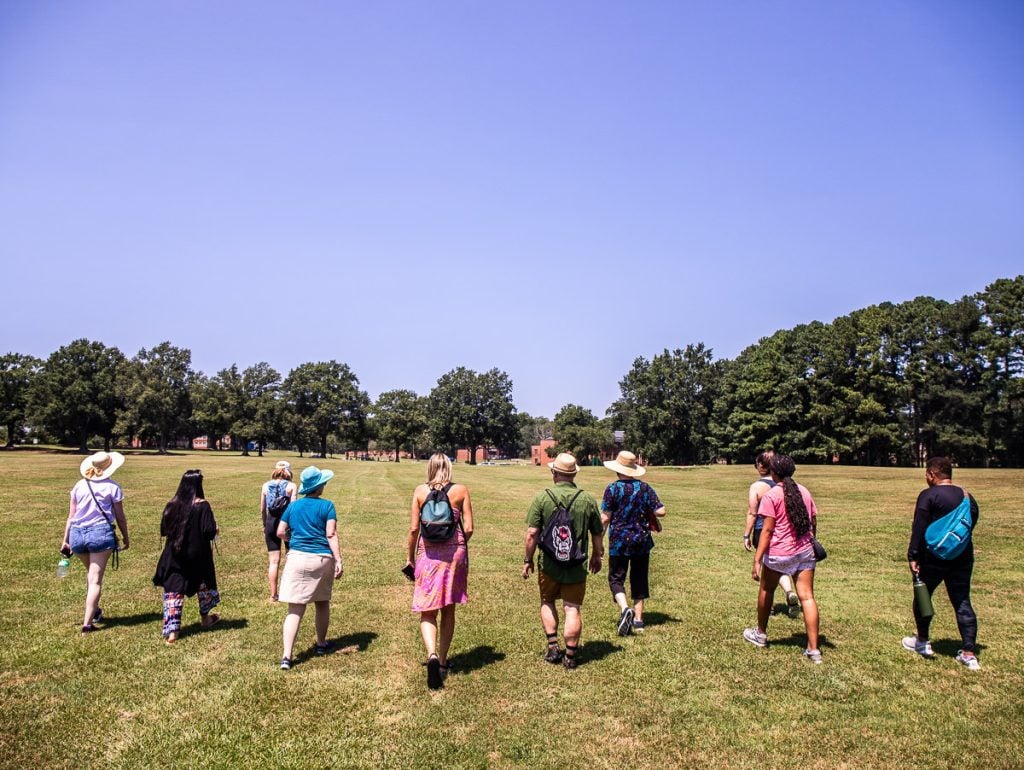
We had a little zen time as we walked down the shady roads around the perimeter of the park before crossing the 35 acres of open meadow at the Big Field, which will remain as is for community events such as Dreamville, which in 2023 hosted 50,000 people per day!
John Hunter and Spring House
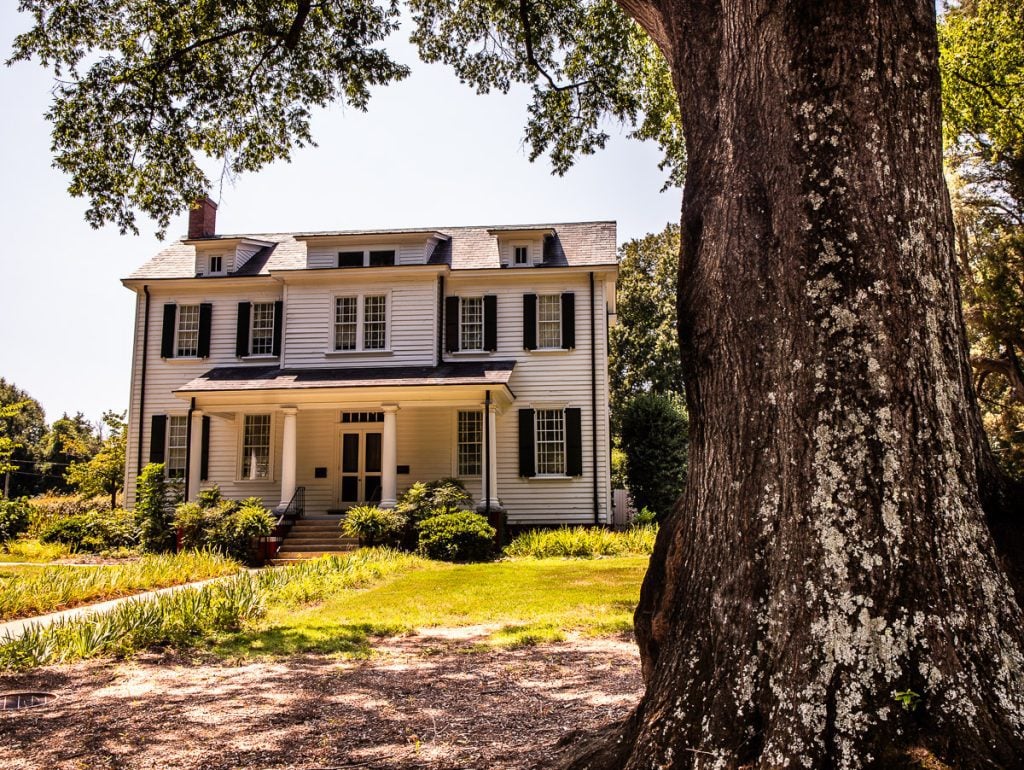
On the other side of the Big Field is our next stop, the Japan House, which is currently owned by NC State Centennial Campus. Formerly Spring House, it is the oldest structure on campus, built sometime between 1816 and 1820 as the plantation home owned by Theophilus Hunter. Adam shared with us a few facts about the 2,500-acre plantation:
- The cash crop here was pork
- This was a large plantation for Raleigh but small for the south
- The home is not as opulent as those plantation homes you’d see in South Carolina. It’s because NC people didn’t show their wealth through opulence. The Mordecai House is another example of this, it’s not grand at all, looking more like a simple farmhouse.
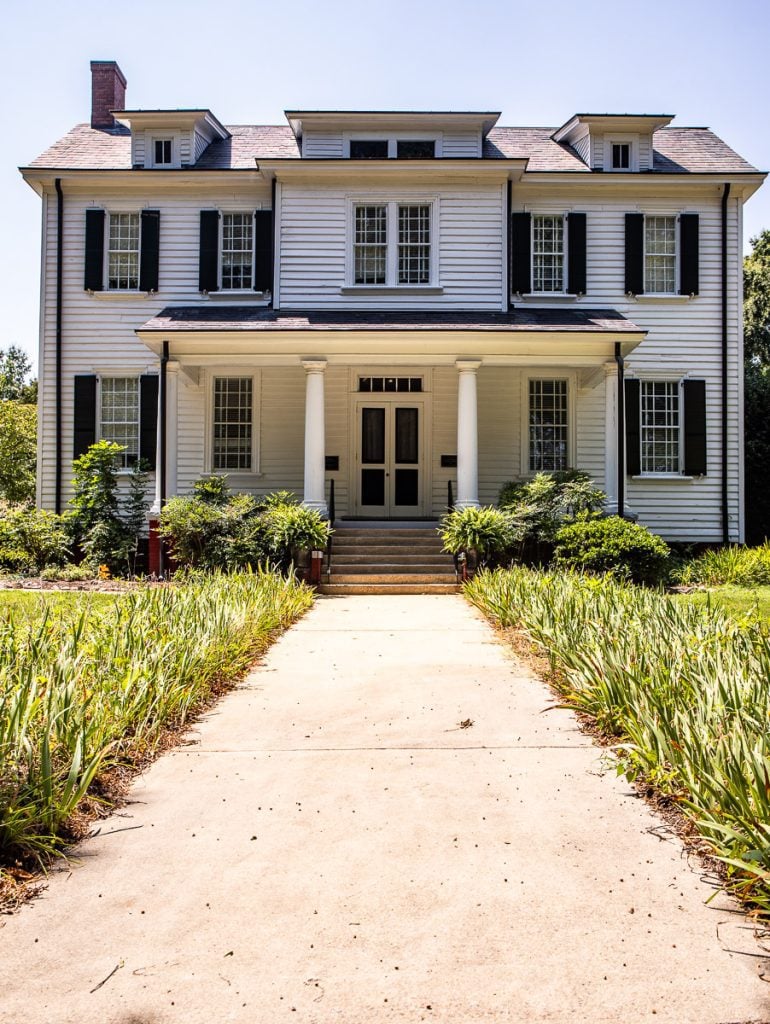
What I appreciated the most from Adam was the time he spent telling us the story of the slaves, who without, this plantation would not have been possible, nor the land that was eventually sold off and given back to the people for us to now enjoy. Theophilus left a unique will that documented all the details of all the slaves. One of those was John Hunter who lived to be 112 and experienced the Revolutionary War, the Civil War and Emancipation.
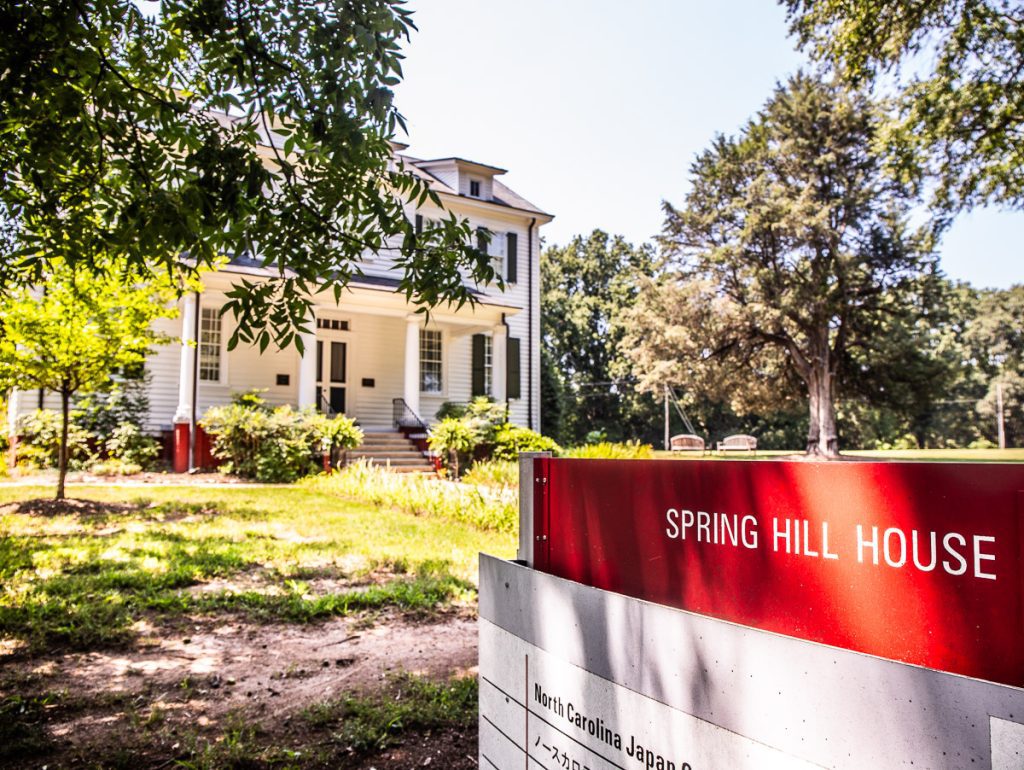
City historian researchers were able to use that information to help find hundreds of descendants of John Hunter. In 2019 they invited them to come to Dorthea Dix to learn more about their ancestors’ important contributions to the city, state and beyond and to celebrate kinship. They have regularly kept in touch and are now planning another reunion this year. Our next stop…
Civil War Stories at Flowers Field
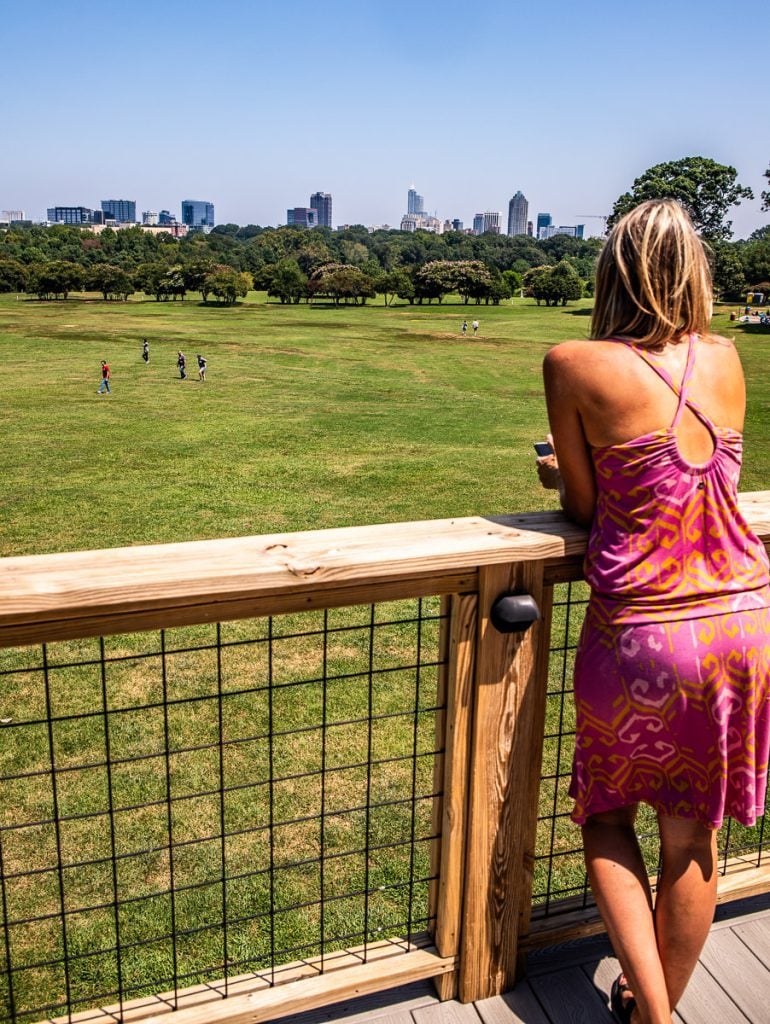
Our last major stop on the tour was one of my favorite places in Dorothea Dix Park, the elegant hilltop Flower Cottage looking out over Flowers Field and the Raleigh skyline. We love the skyline perspective from here, especially when the magnolia trees are in bloom with their vibrant pink flowers. It’s also a perfect spot for a picnic, especially during sunset. Craig and I always comment on what a great cafe or beer garden this deck would be (happy to say it is happening). The Dix Conservancy did finally make a coffee shop by the Gipson Play Plaza though.
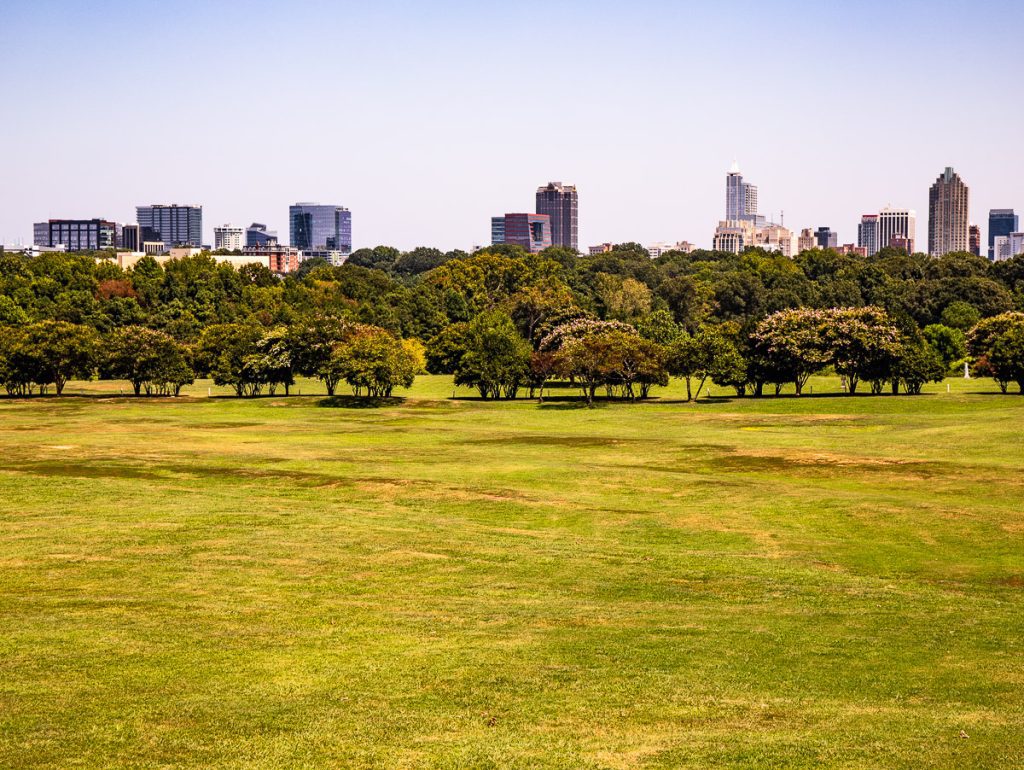
On the deck of the cute Flowers Cottage, Adam told us the interesting story of how this land in front of us was once covered with 10,000 Union tents at the end of the Civil War. Sherman had to go on the train to Durham to sign some surrender documents. When he was about to depart, he received news of Lincoln’s assassination. He told his generals to stay put and keep an eye on the troops.

While he was gone, 2,000 soldiers began to storm the capital in revenge rage. When General Logan could not hold them back, he turned the cannons on them and demanded they return to the hill or else he’d set them off. That is the reason why Raleigh was one of the few cities that did not burn down during the Civil War.
The Cemetery and Sunflower Fields
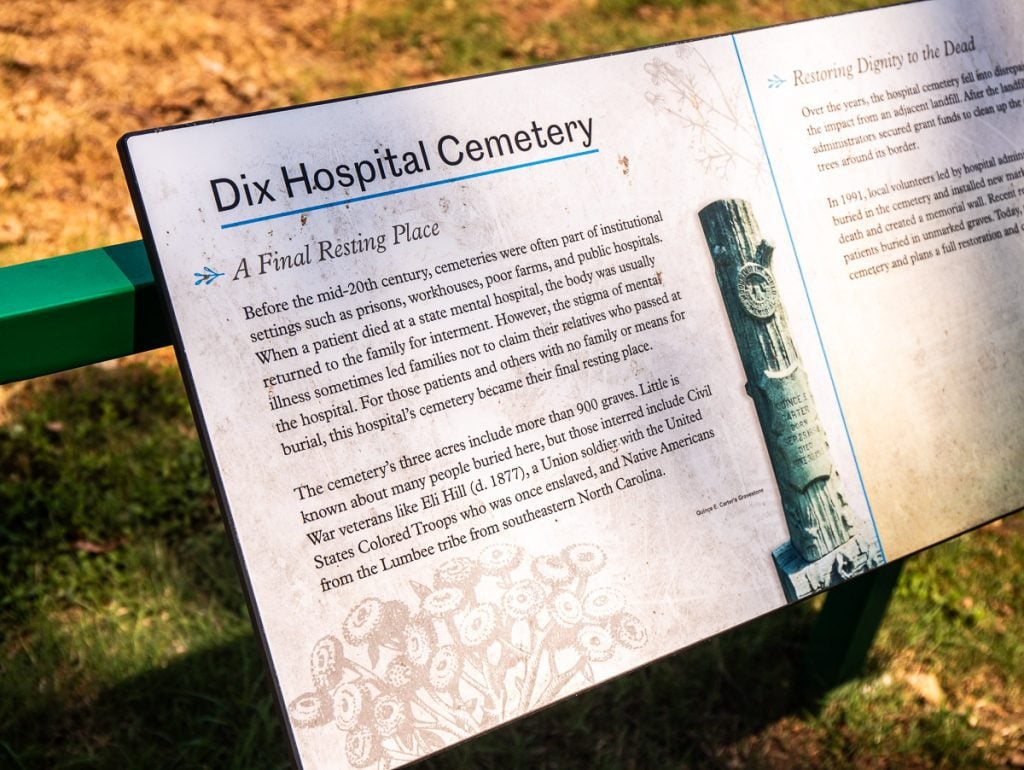
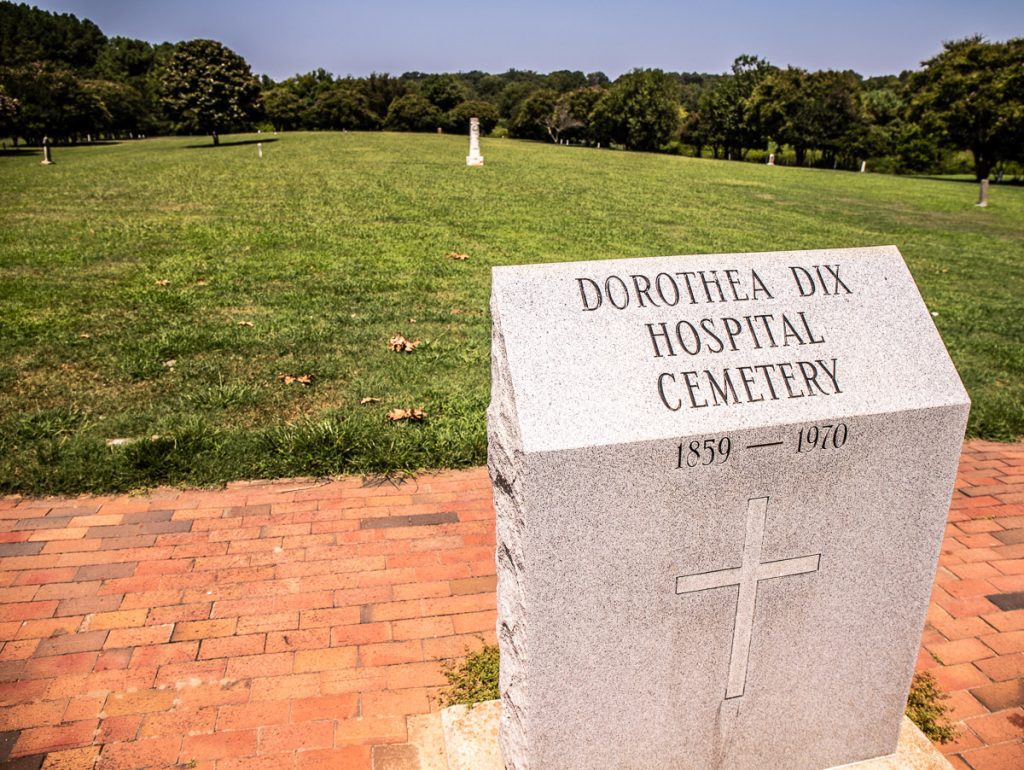
We then made our way back to the chapel, walking past the cemetery that is now the resting home for 900 of the patients (only white patients) from the hospital. There is only a scattering of headstones, but name plates in the ground name 700 of them, just not necessarily where the person was buried.
We then waved goodbye to the dying sunflowers, after we learned about this interdepartmental project between Public Utilities, Office of Sustainability and Parks, Recreation and Cultural Resources. This year, it’s said the sunflowers attracted around 100,000 visitors. They’re not here just to make you look pretty in your Instagram photos. The Sunflower Field at Dix Park serves as a massive pollinator habitat for bees and other species, and they are harvested to process biofuel. NOTE: the sunflowers at Dix Park are typically in bloom around mid-July for about two weeks!

Adam did not send us on our way without telling us the story of the ghost in one of the used buildings. Let’s just say a worker on her own in the building had a meeting with an apparition walking across the hall who turned the lights and radio on! Perhaps some evening ghost tours are in the Dorothea Dix Park plans? Let’s get the paranormal investigators on the case!
If you like ghosts and walking tours, this Raleigh Ghosts and Ghouls walking tour may be your thing! Uncover the lurking ghosts and spirits of Raleigh on a guided paranormal walking tour. Stand as close as you dare to the Heck-Andrews House and listen to chilling tales of this city’s dark history.
Final Thoughts
This free guided tour painted a vivid picture of the park’s metamorphosis, reminding us that beneath its beauty lies a tapestry of significance that enriches the fabric of our city. The serenity of the day, the insights shared, and the sense of connection we felt with our surroundings left an indelible impression. Dorothea Dix Park, once a part of our city shrouded in mystery, now stands as an open book, ready to be explored by all who seek a deeper understanding of its essence.
We encourage everyone to seize the opportunity and join these guided tours, for they promise not only a walk-through time but also an invitation to engage with the remarkable journey that has shaped and continues to shape this remarkable urban park. The two-hour tour takes you around most of the park, giving you time to see all its different parts and beauty and help you envision where it intends to go. It offers time for photos and to chat as you slowly amble across fields and old oak groves!
Check the Dorothea Dix walking tour schedule for dates and times for the next tour – bring a friend. And don’t miss our full guide to Dorothea Dix Park here for more things to do in the park once you’ve finished exploring. If you don’t want to miss cool things to do in Raleigh like this AND important info like when the sunflowers are in bloom, subscribe to our email newsletter.
More Parks & Gardens in Raleigh
Want to see more green spaces in Raleigh? Here are some other helpful guides.
- Lovely gardens in Raleigh and surrounds
- Wonderful Parks in Raleigh to visit
- Historic Yates Mill County Park
- A guide to visiting Umstead State Park
- Top lakes near Raleigh
Stay Connected to Raleigh
Join our free email community to receive free checklists, guides, insider tips, personal stories, fun finds, and the best events in Raleigh each week. We'll show you how to stay connected to Raleigh and love where you live! Join Below 👇
“Your weekly newsletter is a lifesaver for me. Yesterday we didn’t know what to do, I just check your list of events for the weekend, and we ended up in Cary at the Carolina Circus Festival. We had a great time so thanks a lot for all your good work 😊 we really appreciate you” Subscriber
