

Craig was sitting in the car with what we thought was a dislocated shoulder (it turned out to be broken) when I ran into urgent care and asked if they could help him. They said no, he needed a hospital. WakeMed was right across the road, so I asked if we could just go over there. Then they asked about our insurance, and they told me he wouldn’t be seen there. We had to go to a hospital our plan covered.
So, I sat in the car with my husband in a lot of pain and searched my own insurance on my phone to find out where he was allowed to be treated. It was Rex in Holly Springs, another 20 minutes away. A few weeks later the bill arrived. It was over $1,000, and that was just for him to walk through the doors of the emergency room late at night.
This was not long after COVID, when our family had been through some serious financial hardship, and we were already paying a ridiculous amount every month for that insurance. That night is a big part of why this CrowdHealth review is on This Is Raleigh, even though we usually write about restaurants and festivals.
We’re CrowdHealth referral partners, so if you sign up through our link, we earn a commission at no extra cost to you. You also get a discount: your maximum monthly contribution is reduced for your first three months. We paid full price for our first year, and we waited until now to share CrowdHealth so we could tell you how it actually went.
Is CrowdHealth worth it? For our family of three, yes. As of November 2026, our CrowdHealth membership is $181 a month, and the monthly contributions on top have averaged about $220. The cheapest marketplace insurance we were quoted was $1,800 a month.
What we were paying for on marketplace insurance
I grew up in Australia, where healthcare is far more socialized, so American health insurance never made sense to me. We had a wonderful marketplace broker who walked us through everything and found us the best deal she could for our family. When she explained what our $12,000 deductible meant, my response was, “Are you kidding me?”
We were paying $600 a month, and we couldn’t touch most of the benefits until we’d spent another $12,000 on medical costs. I work hard at living a life where I don’t need doctors or hospitals, so for $600 a month I was getting close to nothing. The marketplace plan did cover a wellness check, a mammogram, a pap smear and a colonoscopy, which is great, but colonoscopies aren’t an annual thing and neither are mammograms or pap smears.
When the cheapest quote came back at $1,800 a month
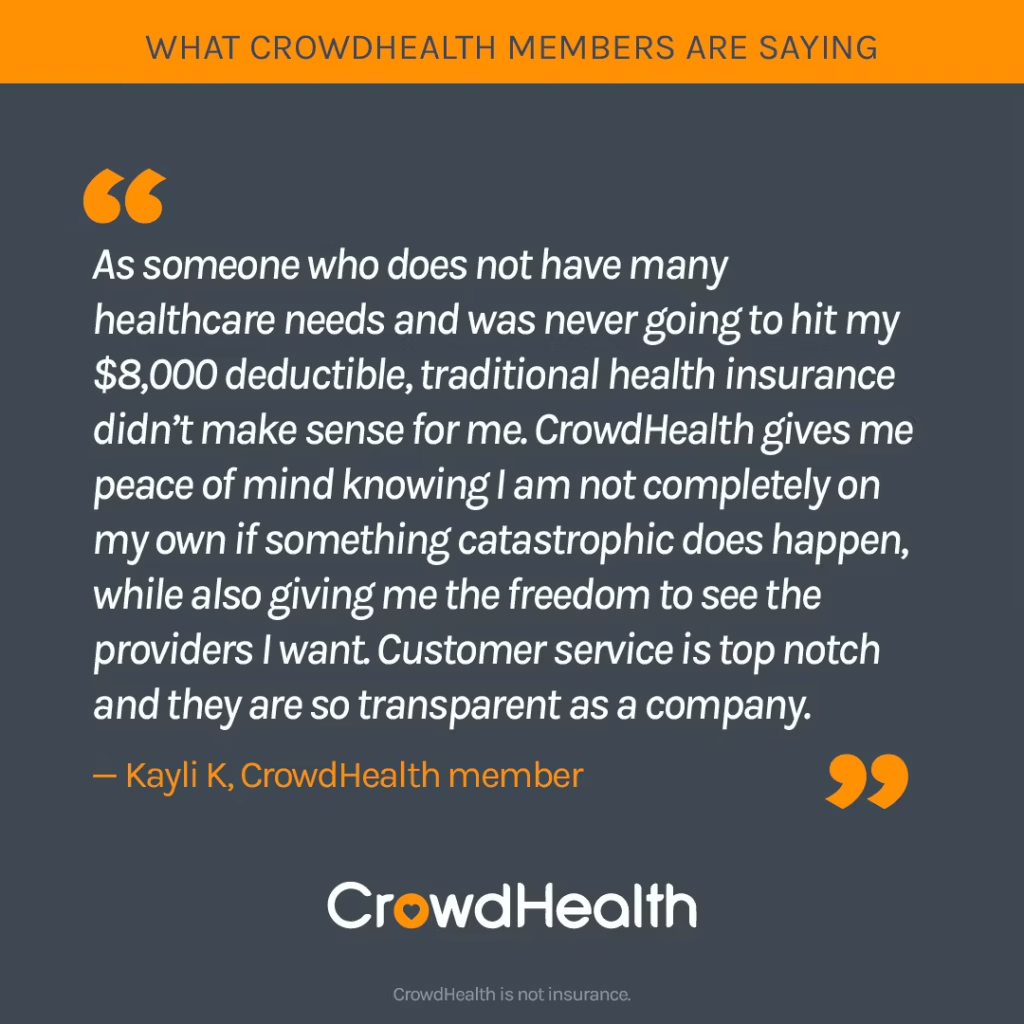
Then our marketplace premium went up to $1,800 a month, and there was no way we could pay that. We’re healthy, so the odds of us needing big medical care are low. But in America, one emergency or unexpected illness can bankrupt a family, so going without wasn’t an option either.
We were scared, because we didn’t know what our options were. We looked at group plans, private plans, and self-employed plans, I spoke to several brokers, and we tried every route we could find with traditional insurance. $1,800 a month was the lowest we could get. We even looked at Christian health-sharing ministries (not my first choice), and they were still quite expensive.
As entrepreneurs, we’re responsible for our own health insurance, with no employer plan to fall back on. And we know a lot of Americans stay in jobs they hate just to keep their insurance. That makes me sad. We’ve built a life doing work we love and changed direction whenever we needed to, and I don’t think anyone should be stuck in a job because of a health plan.
How a This Is Raleigh reader introduced us to CrowdHealth
Craig found Matt Auchtung on LinkedIn, where he’d been posting about CrowdHealth as a solution for entrepreneurs. Craig said, “I’ve seen this thing called CrowdHealth. A local guy is talking about it. I think it might be a good idea. I’m going to reach out to him.”
It turned out Matthew followed This Is Raleigh, and he got on the phone with us. He was personable and easy to talk to. He explained what CrowdHealth is, why it was created, why he switched over 4 years previously and would never go back, what it would cost us each month, what we’d get in return and how its version of a deductible (heath event) works, and he walked us through a few scenarios so we could picture it.
By the end of the call we were asking, “Where do we sign up?” It lined up with what we believe in, and it was going to save us a lot of money.
How CrowdHealth works
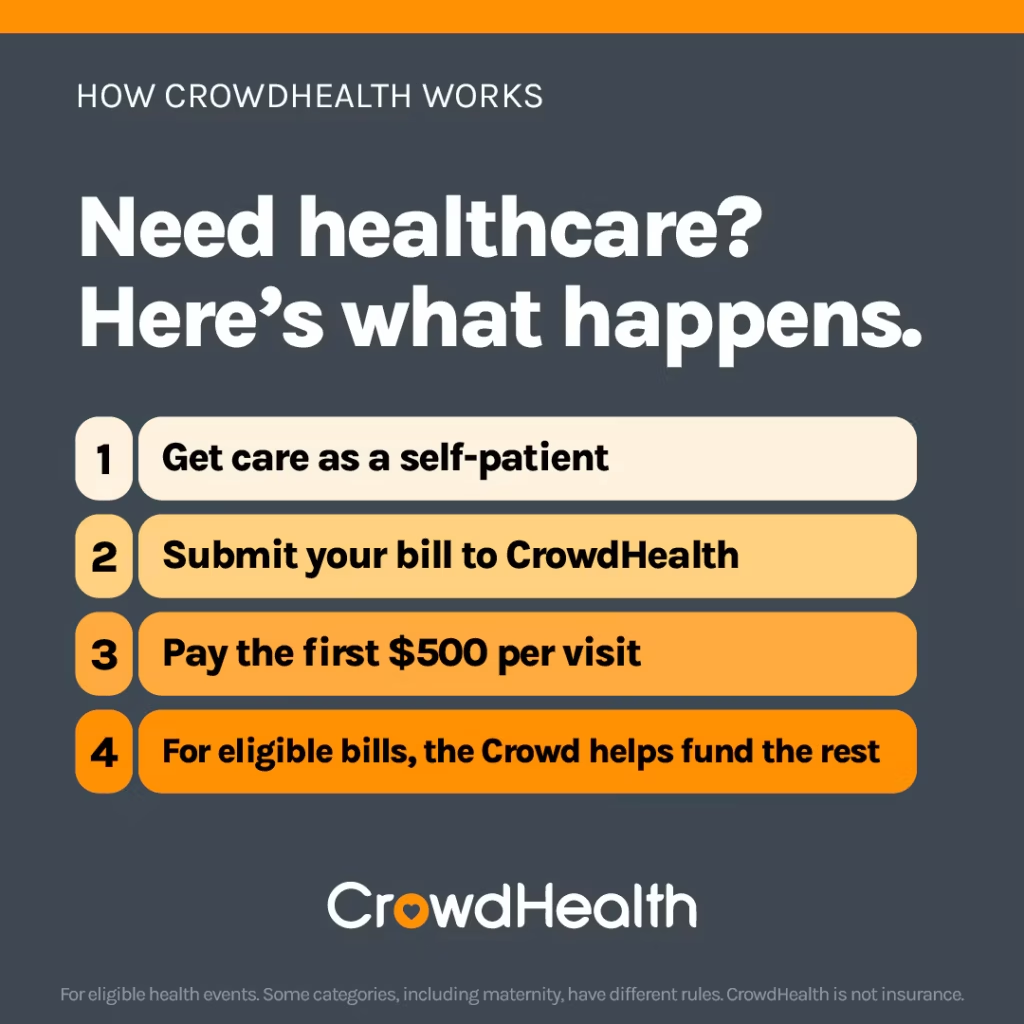
CrowdHealth isn’t insurance. You pay a monthly membership, and each month you also contribute toward other members’ health events, with a cap on how much you can be asked to pay. When you have a health event, you’re responsible for the first $500, which works a lot like a deductible. You pay as a self-pay patient, CrowdHealth helps you find and negotiate the best self-pay price, and then you submit the event in the CrowdHealth app to be funded.
Self-pay prices surprised me. For a lot of care, the self-pay price is much lower than what you’d be billed with insurance, before you even count the premiums and the deductible.
There’s also $300 a year toward an annual wellness visit or a screening like a pap smear, and you choose what to use it on.
In summary, CrowdHealth is a community of people who help pay each other’s medical bills. You pay a monthly membership fee, plus a separate contribution each month toward other members’ bills.
Say you break your arm. You’ve got your own care advocate, a healthcare sidekick, to help you through the whole process. You get the care you need, pay the cash-pay rate (which is almost always going to be way lower than the inflated insurance rate), then send CrowdHealth the bills. You pay your portion, and as long as it’s an eligible medical need, they ask the community to help fund the rest.
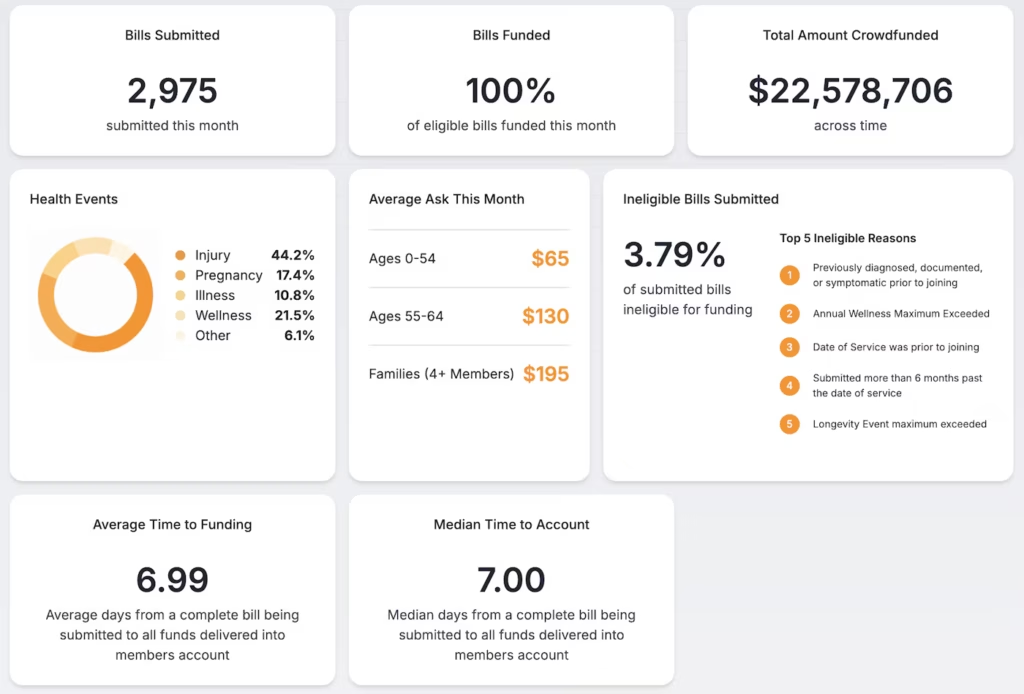
And it works for the really big stuff too, like one member’s $3M bill for their baby’s NICU stay. To date, 99.9% of eligible bills have been funded. The typical cost is 30-70% less than you’d pay for traditional health insurance.
CrowdHealth advocates
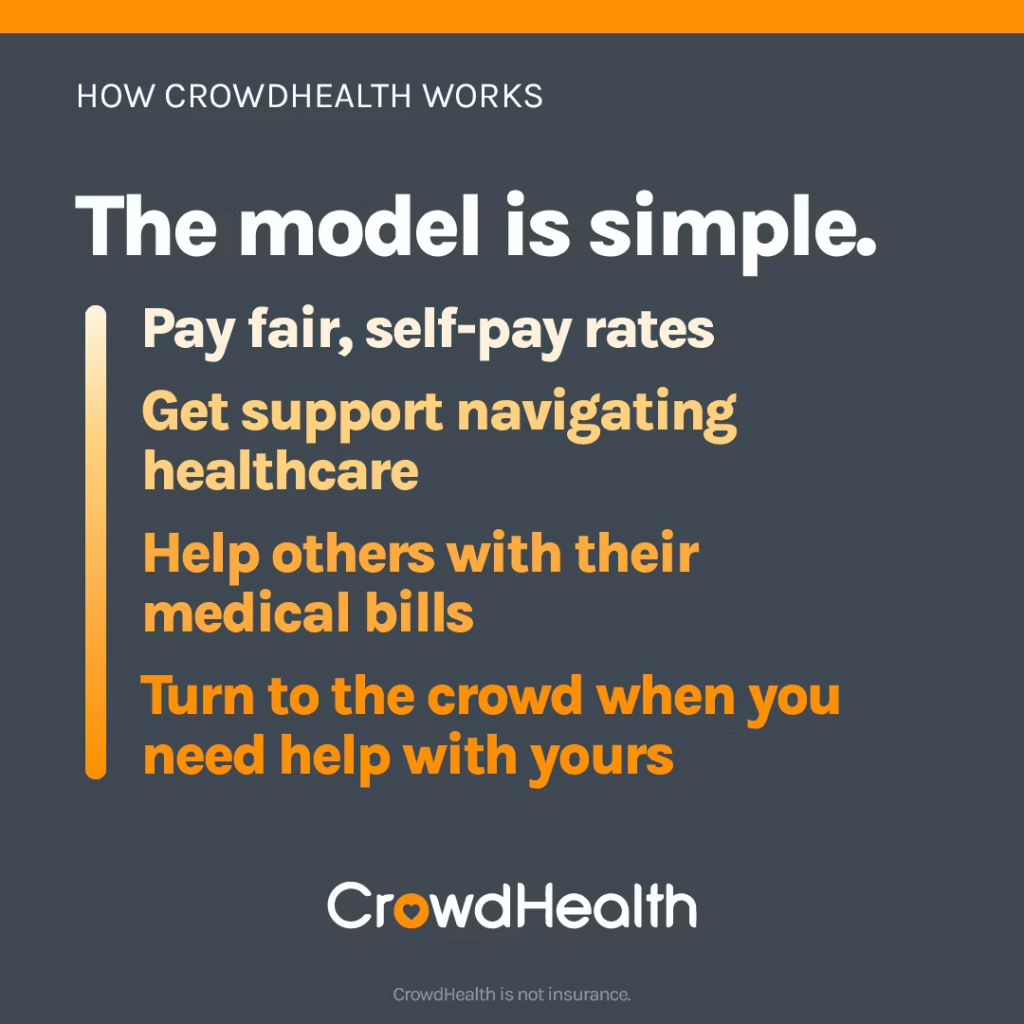
Getting help from your CrowdHealth advocate is as easy as logging into the app and opening the chat, and their response time is surprisingly fast. Your advocate can answer your questions, point you to medical providers in your area, negotiate better self-pay rates, walk you through submitting a health event and keep you updated while that health event is being funded.
My colonoscopy was a little complicated, and our advocate Sarah was great at helping me work through it. She gave me the steps I needed to take to get the cheaper option through CrowdHealth, so I wasn’t stuck paying the higher price (more on that below).
So far, my health events have been funded quickly, and the app keeps me updated as the funding progresses. Once a health event is funded, I press a button and the money is transferred into my bank account.
Choosing your own doctor with CrowdHealth
We had the same family doctor for several years. Then we had to change marketplace plans to something we could afford, and just like that, our doctor was out of network. We had to find a new doctor, which isn’t always easy because so many aren’t taking new patients.
It was beyond frustrating that we couldn’t choose our own doctor, and that we had to start over with someone we didn’t know and build that rapport and trust again. Our daughters were so annoyed. They loved their doctor, who knew them and their history and was a great advocate for them.
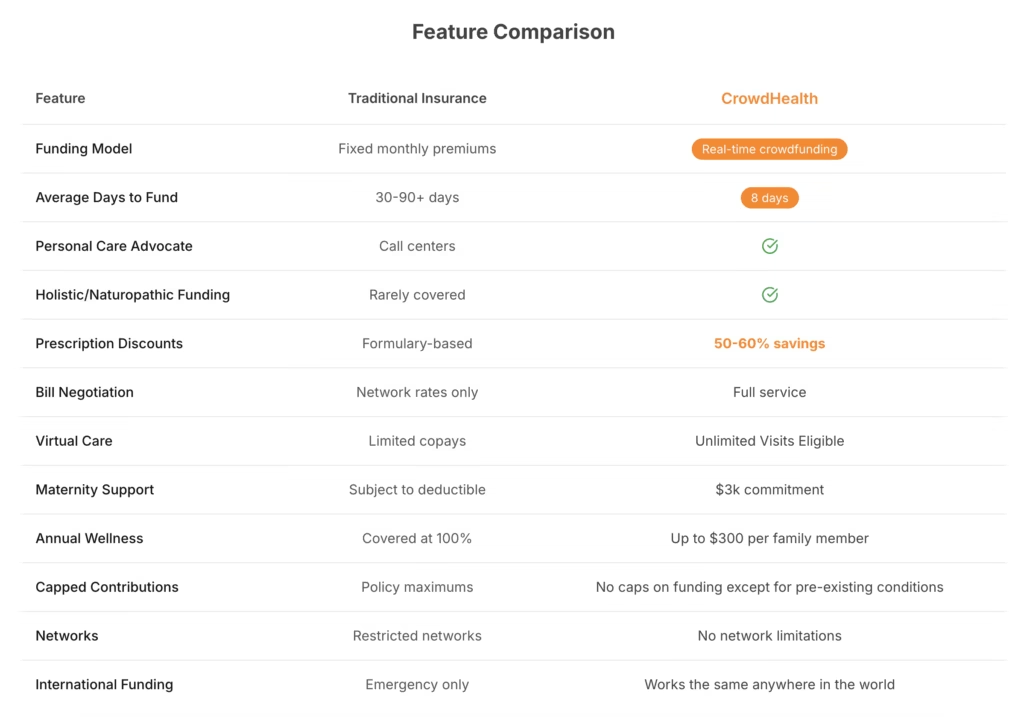
CrowdHealth doesn’t have networks, so we can see whichever doctor is right for us, for any kind of care, and nobody can make us switch.
No surprise tax bill with CrowdHealth
This one was one of the biggest selling points for us, and I almost forgot to include it. With CrowdHealth, we know what we’re spending each month, and we’ll never get a huge bill at tax time to pay back marketplace subsidies because our income went up.
We’re entrepreneurs, so our income goes up and down, and of course we want it to go up. Who doesn’t want that for their business?
When you sign up for a marketplace plan during open enrollment, you estimate your income for the year, and your premium tax credits are based on that number. You have to watch it closely, because if you earn more than you predicted, you pay back some of those credits when you file your taxes. That’s a big risk for entrepreneurs and anyone else whose income changes from year to year.
It happened to us when we first joined the marketplace and didn’t really understand how it worked. We chose a plan we thought was great, but it was far more expensive than what we needed, and then our income ended up higher than we’d projected. It was a better year with our business we didn’t see coming, and at the end of it we got a $15,000 bill. It hit us hard, and it hit us right around COVID! w. We never want to go through that again. With CrowdHealth, I don’t have to worry about it.
What our first year on CrowdHealth actually cost
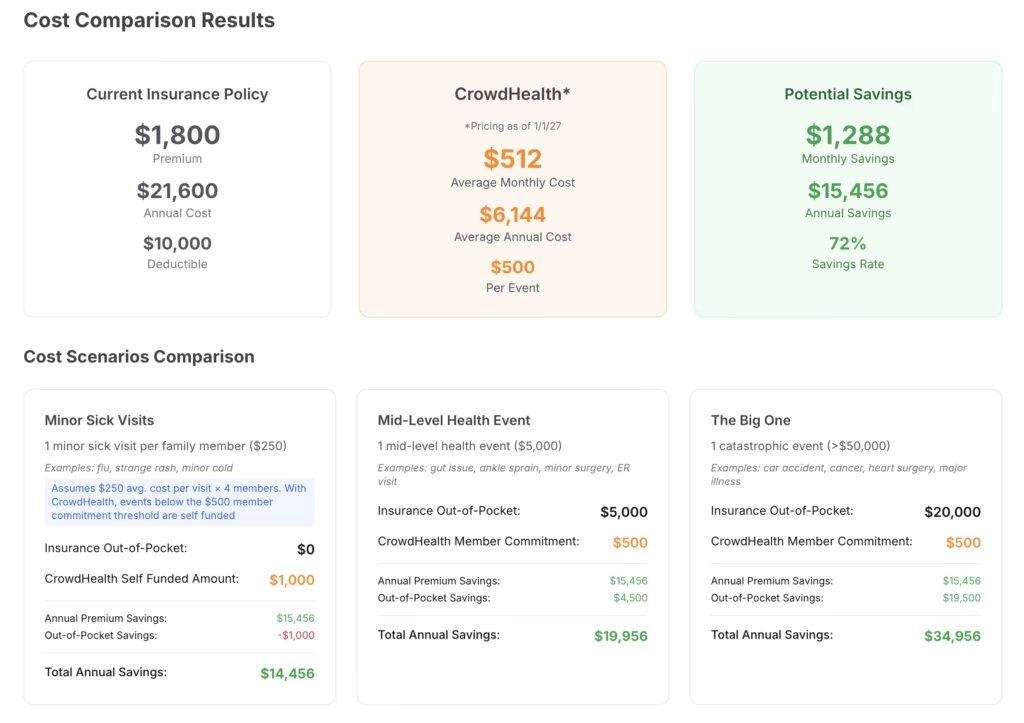
We waited almost a year before sharing CrowdHealth as a stellar health insurance alternative, because we wanted to know how we felt after living with it. Our membership is $181 a month for Craig, Savannah and me, and the monthly contributions have averaged around $220. All in, that’s about $400 a month, against the $1,800 we were quoted.
I’ve used it three times this year. Savannah and I both had our annual wellness visit. Mine covered my doctor visit and labs done for me there and then. I recently had a colonoscopy, which turned into the clearest example of how different this has been.
I have a family history of colon cancer, and three years ago I was told I needed a screening. Through CrowdHealth I was connected to Colonoscopy Assist, which found me a colonoscopy cheaper than the self-pay price I was quoted through my doctor’s referral. Colonoscopy Assist needed a lab order from a doctor, and my doctor refused to write one. He said he had to send a direct referral to a colonoscopy center or a specific doctor.
That frustrated me no end. This is my body, and it’s my money. If I couldn’t go to the place that was significantly cheaper, I couldn’t afford the screening I’d been told I needed.
CrowdHealth stepped in again. Members have access to virtual care doctors, and the visit (usually around $130) was covered for me. The doctor talked through my screening with me and wrote the lab order, and I booked my colonoscopy for two weeks later. The center my doctor wanted to send me to wouldn’t tell me the full cost upfront, including the anesthesia, which is one of the big costs with a colonoscopy. So, I can’t tell you exactly how much I saved, as I could not get the full price. But what I paid was almost the same as what I was quoted without the other costs.
Colonoscopy Assist told me every cost before I booked, the staff at the center were efficient and kind, and the whole experience was wonderful (and let’s face it, nobody usually calls a colonoscopy wonderful).
I’m in the middle of submitting it now, so I’m still finding out whether CrowdHealth reimburses the whole cost or everything after my $500.
CrowdHealth membership also includes virtual talk therapy. The cost of a therapist adds up quickly, and it can be the thing that stops people from getting the help they need. We’ve used it for our daughter as part of our membership. It’s virtual only, which won’t suit everyone (I prefer in-person myself), but if it means someone can get the care they need at no extra cost, that’s a big benefit of the membership. You can also choose the therapist you feel most aligned to!
A breakdown on what CrowdHealth costs
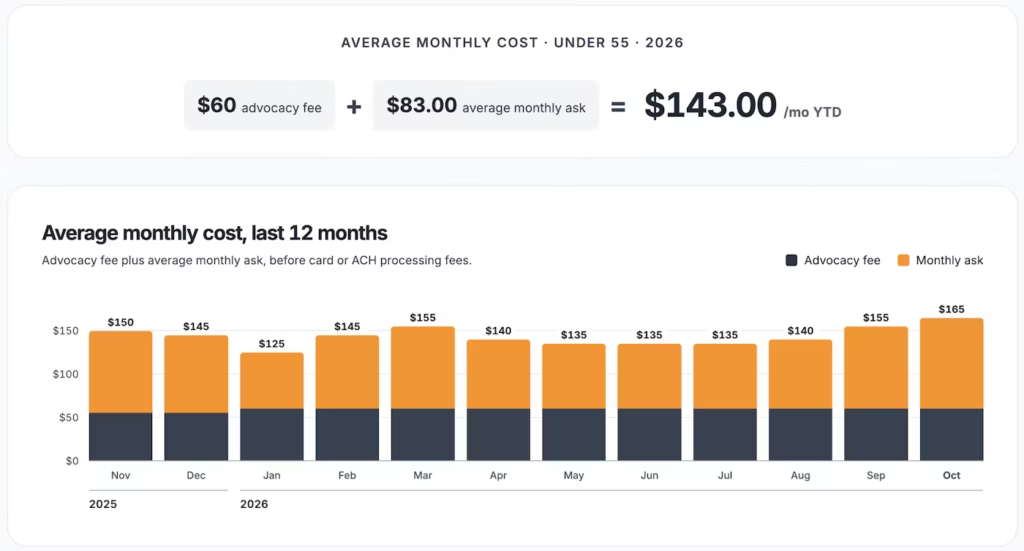
There are three parts: a $60 monthly Advocacy Fee per Member, monthly crowdfunding contributions, and your Member Commitment when you have an eligible health event.
Here’s the breakdown:
- Advocacy Fee: $60 per Member per month for Care Advocacy, bill negotiation support and more
- Crowdfunding contributions: These vary each month, depending on the needs of the Crowd that month, with maximums of $140 per Member ages 0–54, $280 per Member ages 55–64, or $420 per family with four or more Members.
- Member Commitment: The first $500 of each eligible health event, or $3,000 for an eligible maternity event.
The crowdfunding maximum is separate from Advocacy Fees and Member Commitments. Expenses that aren’t eligible for crowdfunding or one that are less than your member commitment of $500 are also your responsibility.
What hasn’t been perfect
Women’s health screenings are the biggest difference. On traditional insurance, mammograms, pap smears and colonoscopies are usually covered. On CrowdHealth, they aren’t covered the same way.
Self-pay prices for those screenings have been much lower, though. My pap smear cost me about $150. If I add up roughly $150 for a mammogram, $150 for a pap smear and $500 for the colonoscopy, it still comes to less than one month of the $1,800 premium. Mat told us this upfront, and I ran the numbers before we signed up.
CrowdHealth also has a prescription discount card. My regular prescriptions cost the same as they did on traditional insurance, so for me it hasn’t changed anything there.
The other headache wasn’t CrowdHealth at all. Our eldest daughter couldn’t join our plan because UNCW only accepts traditional health insurance, so she’s on a Blue Cross Blue Shield plan through the university at around $1,500 a semester. It annoyed me, because I believe families should be able to choose the healthcare that’s right for them and take responsibility for that choice. Even with that extra cost, staying on CrowdHealth for the three of us still works out much cheaper.
What you give up with CrowdHealth
CrowdHealth isn’t an HSA-qualified health plan, so you can’t keep contributing to a health savings account. That didn’t matter to us in the end, because the HSA-qualified plans were too expensive for us and we couldn’t use one in our last year on the marketplace. If contributing to an HSA is important to you, it’s worth factoring into your decision. Money you already have in an HSA can still be used for eligible medical expenses.
Even counting the HSA, CrowdHealth still costs us far less than the $1,800 a month we were quoted for marketplace insurance.
You also do more of the legwork yourself than you would with traditional health insurance. You ask providers for the cash price, request itemized bills or receipts, and submit them to CrowdHealth, and sometimes that means calling a provider’s billing department to get the paperwork. You also pay your providers yourself. Your Care Advocate will explain the process and answer your questions along the way, but they won’t make those calls or payments for you.
I haven’t found this to be a big deal, and I think I prefer it. I’m more involved in my own health now and understand how all the pieces fit together. Before, I handed everything over to the insurance company without really understanding what I was paying for or why. Now I know enough to say, “Hang on a minute, this doesn’t make sense,” and push for a better price.
Who we think CrowdHealth suits
From our year, it’s worked well for a healthy family that spends its money on preventive wellness and wants to stop paying huge premiums for coverage it barely uses. It also makes a lot of sense for entrepreneurs and the self-employed, who carry the full cost of their own insurance.
We spend a lot on preventive wellness, and traditional health insurance doesn’t cover any of it. Saving on monthly costs means more of our money goes toward staying healthy.
You have to run the numbers for your own situation to see what your best choice is, as it all depends on your heath and financial situations. For us, it was a no-brainer. CrowdHealth or nothing. It turned out to be the best decision, we’ve saved a lot of money, have received excellent care and support when needed, and have had the minimal health events we’ve had funded.
I doubt we’ll ever return to traditional or choose any other alternative. It’s been a gamechanger for us and our hope in sharing is it may help another Raleigh resident faced with difficult health care decisions and unaffordable health care costs.
Common questions about CrowdHealth
How much does CrowdHealth cost per month?
Our family of three pays a $181 monthly membership, plus monthly contributions toward other members’ health events, which have averaged about $220 for us. The contributions are capped.
Is CrowdHealth insurance?
No. It’s a health-sharing community. You pay the first $500 of each health event, pay providers at self-pay prices and get reimbursed through the CrowdHealth app.
Does CrowdHealth cover women’s health screenings?
Not the way traditional insurance does. There’s $300 a year toward a wellness visit or a screening, and self-pay prices are much lower. My pap smear was about $150.
What if I have a preexisting condition?
You can’t submit costs related to a previously diagnosed or documented condition during your first two years of Membership. Starting in your third year, up to $25,000 per year in related bills can be submitted for crowdfunding. If you have an ongoing condition, discuss it with CrowdHealth before joining. Don’t assume a particular condition is exempt from these rules
Are there treatments or expenses that aren’t eligible?
Not every treatment or expense is eligible. Examples include cosmetic procedures, long-term prescriptions, and fertility or infertility treatments. Previously diagnosed or documented conditions have waiting periods and funding limits. Eligible prescriptions related to a health event have a 12-consecutive-month limit. Research to find out all ineligible conditions
Can I keep my doctor?
Yes. CrowdHealth doesn’t have doctor networks restricting who you can see. You can keep seeing your favorite doctor or ask your Care Advocate for help finding someone new
Can I join CrowdHealth at any time?
YES!! You do not have to wait for just one month of the year to join a program that supports your health and wellness. Unlike traditional marketplace insurance, you can join Crowdhealth at any time! Another thing about health insurance that baffled me.
Is CrowdHealth funding guaranteed?
CrowdHealth isn’t insurance, and funding isn’t guaranteed. CrowdHealth’s track record is that 99.9% of eligible medical bills have been funded by the community. You also have help along the way: CrowdHealth helps members find fairly priced care, negotiate bills, and submit eligible expenses for crowdfunding.
Why we’re sharing CrowdHealth now
Open enrollment is happening right now, and I know a lot of you are looking at those monthly numbers and feeling the same knot in your stomach we did. If the marketplace isn’t working for your family, CrowdHealth is worth a phone call.
If you sign up through our CrowdHealth link, your maximum monthly contribution is reduced for your first three months, and we earn a referral commission. (Our referral code is also CAZMAK if you’re asked for it.) If you have questions about our experience, send me a message. I’m happy to tell you what we’ve learned. We’ve pretty much laid it out in this review but I know sometimes you may want extra clarification as it’s a big decision.
Stay Connected to Raleigh
Join our free email community to receive free checklists, guides, insider tips, personal stories, fun finds, and the best events in Raleigh each week. We'll show you how to stay connected to Raleigh and love where you live! Join Below 👇
“Your weekly newsletter is a lifesaver for me. Yesterday we didn’t know what to do, I just check your list of events for the weekend, and we ended up in Cary at the Carolina Circus Festival. We had a great time so thanks a lot for all your good work 😊 we really appreciate you” Subscriber
